
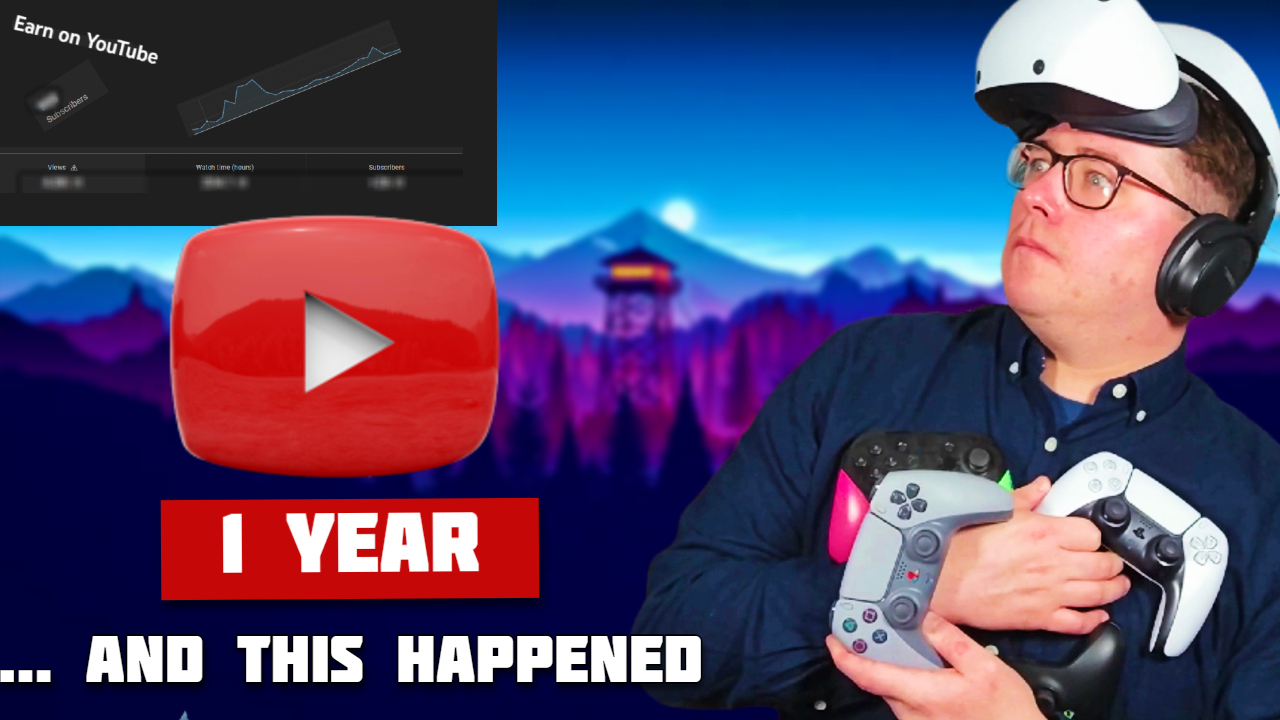
I Spent 1 Year as a Gaming YouTuber – This Is What Happened
I have now spent 1 whole year making videos about video games on YouTube, and today, I’m going to take you through everything from subscribers, monetization, watch hours, the almighty algorithm, the equipment I use and what it cost, the emotional ups and downs I went through posting consistent content, and ultimately whether I think it’s worth it and what I learned along the way. For my subscribers, you can see this as a 1-year behind the scenes update to see exactly what goes into making these videos. For everyone else who’s just curious about getting into the YouTube gaming sphere, this will be a realistic look into the dedication it takes and the results you can (more or less) expect to see if you do the same. So, let’s go through 1 year of YouTube gaming together.
The money pit before the storm
When I first had the idea for starting a YouTube channel about gaming, I wanted it to be – primarily – a place where we could delve deep into gaming topics. I wasn’t really interested in being some kind of 2010 let’s player. So, that meant that I wanted to focus on making longer form, more polished videos. In turn, this meant that I would likely need to write scripts for the majority of my videos. Which also meant I’d need a way to read those scripts while looking at the camera. So, I bought the Elgato Face Cam Pro and the Elgato Prompter. Then I decided to use a green screen, so I bought one of those and some lighting too. You can’t have good video quality without good audio quality, so I also bought the Samson Q2U XLR microphone. I tied all of these together with a Stream Deck Plus, which allows you to control your lights, recording, streams, voice levels, and so on. It’s easy to see how this can become quite a money pit, as you always need that one extra thing to make the thing you just bought work properly. If you want a setup similar to mine, then you’re looking at spending roughly $1000. But I will also say that you do not NEED this equipment – if you’re on a budget, then just turn on your camera and start talking, because ultimately, it’s all about who you are and what you have to say (more on that later, but let’s just say I was very surprised by what I found out).
Commitment and content
Okay, so I summarily drained my bank account to purchase the equipment that I wanted to create videos the way I wanted to. So what happened next? Well, I had to commit to actually creating content. I figured that I would aim to produce at least 1 video per week because, in general, I knew I would have to spend quite a lot of time writing the video scripts, recording the videos, and then editing them. My first few videos were about gaming topics that were newsworthy at the time, mainly because I wanted to gain some experience in how to create and edit videos before I started making the long-form, deep dive videos. It wasn’t long, though, before my first two documentary slash essay style videos (if that’s what you want to call them) were published: the first one about the 10th anniversary of The Order 1886, and the second charting the history of Remedy Entertainment.
Now, let’s talk about expectations for a second. We’ll analyse this a little deeper in a little while, but let’s just say that I didn’t start this channel to become some rich and famous YouTuber but rather as a creative outlet, where I could share the more thoughtful analysis, critique, and history of video games with other like-minded people. However, my video titled From Indie Dev to Powerhouse – the rise of Remedy was the first proper documentary-style video that I created, and I considered this the first true test of whether people would be interested in my content or not. I spent roughly 40 hours researching, writing, recording, and editing the video. At the time, I thought that was because I was new to content creation, but I would soon realise that that’s the amount of time it takes to produce most of my longer-form videos. The rise of remedy was published on April 12th, 2024, and even though I waited with baited breath to see all of my work pay off, it landed to a big flop. Even today, this video has only 38 views, which was a disappointment considering the amount of time and effort I put into it at the time. But, it taught me two things: 1) You’re at the mercy of the YouTube algorithm and whether it even shows your video to anyone, and 2) you have to keep going.
I kept releasing at least 1 video per week, and soon enough I would have my first quote unquote viral video. On May 17th of 2024, after watching the Fallout TV show and thinking to myself that it was so much more enjoyable than the games because Todd Howard always releases broken messes, I published a video called Why You Don’t Actually Enjoy Playing Fallout. This video was divisive, with half the Fallout community giving me thumbs down and calling me stupid in true internet style, while the other half of the community said I was right. This video has just over 5000 views today and was the first video where I started getting comments saying things like “your videos are good, how do you not have more subscribers?”. Truth be told, this was exactly what I needed at the time because I was battling the age old demons that tell you you can’t do things and nobody likes you. Hot on the heels of that success, I released another video called “How Phil Spencer Let Us Down and Ruined Xbox”, which went through the history of Microsoft’s console and showed how we got to this strange place where Xbox just… doesn’t really stand for anything anymore. This video gave me a big subscriber boost and hit 22,0000 views.
Things were going great then, right? Not quite. See, over the next few months, my videos got anything from just 19 views to 3 thousand, with no real noticeable pattern. Sometimes a short, off-the-cuff video would get more views than a video I spent countless hours toiling away at. And even when I did have “successful” videos, which got hundreds and thousands of likes, that didn’t translate into subscribers – an important metric for getting monetised. More on that soon. Despite putting out at least 1 video per week, sometimes more, growth stayed relatively slow until the end of November 2024, when I published a video called “Why You should play boring games”. This video is all about how simulator games, which first appear boring, can slowly take over your life. Ironically, while still edited and written, this one had far less research put into it than some of my other videos. It must have hit the YouTube algorithm at the right time and place because it got 59 thousand views, 3.3 thousand watch hours, and 387 subscribers (even though over 3000 people liked the video, COME ON GUYS JUS—). From then until now, however, we’ve been back in a lull and at YouTube’s mercy as to whether my content is even shown to people.
Views, subscribers, monetisation
So, now it’s time to give you the full channel analytics and transparency on numbers. As it stands right now, I have 945 subscribers, 140,000 views, and 2.2 million impressions. I’ve published a total of 122 videos – some of these are YouTube Shorts and livestreams, but the majority are proper videos. Now, let’s talk about monetization. You need 1000 subscribers and 4,000 watch hours to monetize your YouTube videos. People usually get the subscribers first and then struggle to hit the 4,000 hours watched mark. Interestingly, I hit the 4,000 watch hours milestone ages ago, but I’m still 55 subscribers short of being monetized. As I said at the beginning, I didn’t start YouTube to make money, and I’m giving you this information so that you have more in-depth knowledge if this is something you’re thinking of getting into, but it would be nice to get monetized just so that it’s another YouTube hurdle out of the way (if you’re not subscribed, how about giving that button a little tickle to help me out. Come on, you know you want to).
Expectations, results, and hidden YouTube lessons
YouTube is a strange place, and being a creator on the platform is not for the faint of heart. I dedicate around 40 hours a week to this, give or take, and it truly is like having a second job. When I started creating YouTube videos a year ago, I never expected anyone to view my videos or even subscribe. I started out by simply creating the kind of content I found interesting, and not really expecting anyone else to watch them or find them compelling. Nobody tells you how invasive it feels to record yourself talking to a camera and publish it on YouTube for the entire internet to watch, but I think that fact is one of the hidden benefits of committing and following through on consistently making YouTube videos. You get more comfortable putting yourself out there and it boosts your confidence in your day-to-day life. It also makes you a better speaker, writer, editor, and the list goes on. Making YouTube videos consistently has certainly allowed me to develop my skills a lot, and it is rewarding when people enjoy the content you have put hours and hours of hard work into, but it’s also a marathon and not a sprint. You have to keep a positive mindset and motivate yourself to keep grinding, even when videos are not pushed by the algorithm.
And that brings me to what they don’t really tell you about YouTube. The major frustration is that the effort you put into videos, thumbnails, descriptions, tags, and other general woo-woo witchcraft doesn’t translate into success. All of that helps, of course, but at the end of the day it is the YouTube algorithm that dictates how many people your video will be shown to, and not even YouTube understands how it works. I have videos that I thought were really well polished that were only shown to a handful of people, and that’s what stings the most when you do YouTube consistently; it’s not the fact that people don’t want to watch, it’s that sometimes people aren’t even GIVEN the chance to click on your video based on some arbitrary AI rules. You simply have to create your video, upload it, publish it, and roll the dice with the algorithm gods. That’s why, when it comes to creating YouTube videos, persistence is what pays off the most. If you’re serious about becoming a YouTuber, then your best strategy is to think about what niche you are either passionate about or have a lot of knowledge in, and then delusionally produce videos on that topic with a regular cadence. Don’t have any expectations for success, but make the best videos you can. And above all, be unapologetically yourself. People WILL leave mean comments because it’s the internet, but people will also leave nice comments or just enjoy your videos and leave – and that’s fine too. So, while it might seem like an uphill struggle that you want to talk yourself out of, everyone has something to say about their passion, so why not just turn on the camera and see what happens? A year ago, I never thought I’d have the amount of subscribers that I do now, but here we are. And yes, a year does seem like a long time when you think about it, but it will absolutely fly by. Now, if you’ll excuse me, I’ve got a trello board full of video ideas I need to get back to. Which ones will YouTube recommend? Who knows!


