
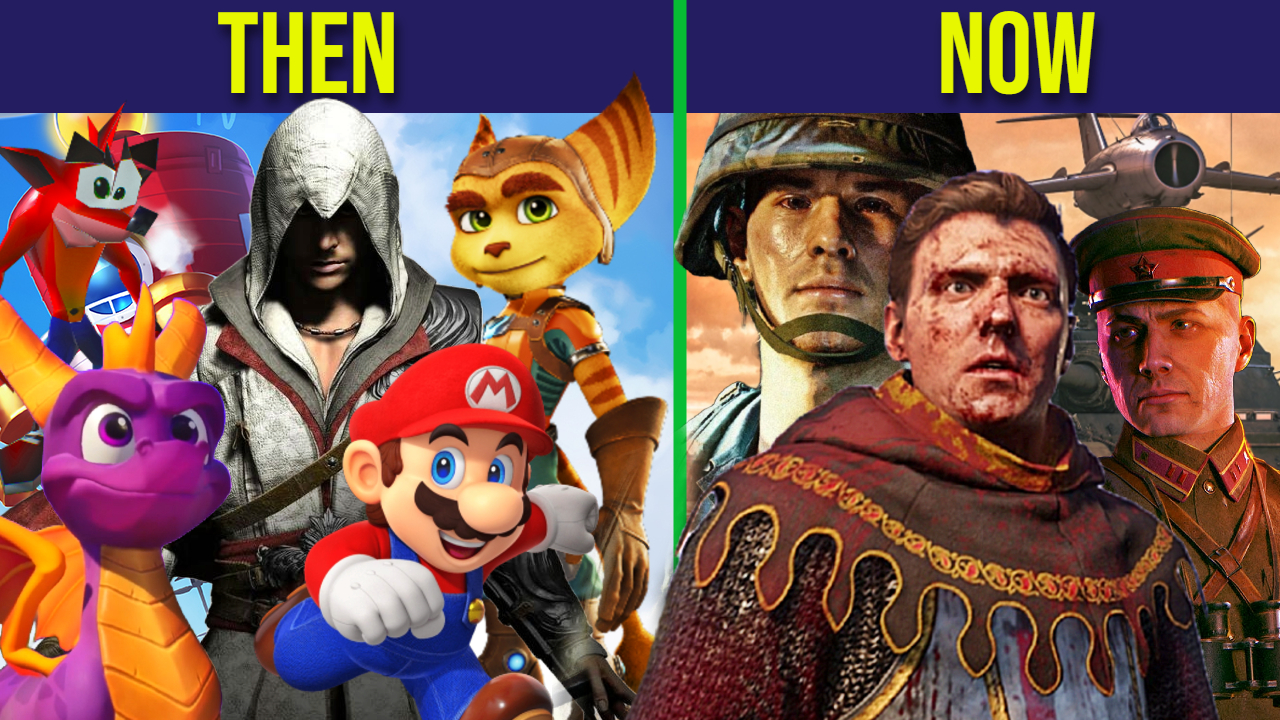
Why Are Gamers Changing?
It doesn’t take a genius, or even Henry of Skalitz, to know that Kingdom Come Deliverance 2 took the gaming world by storm. This medieval RPG has been praised for its Monty Python-esque humour, and we’ve all been getting lost in its world, which simulates the daily life of normal people during history’s dirtiest period – literally, because there’s mud… just… everywhere. But, the popularity of Kingdom Come Deliverance 2 set my tism senses a’ringing – why is a series that, a few years ago, sat in a niche within a niche now one of the most popular releases of 2025? So, I headed over to Steam DB to have a quick look at the numbers, and sure enough, Kingdom Come Deliverance 1 had 100k peak players at launch, which quickly dropped to 4-8 thousand. The sequel, on the other hand, had over 250 thousand peak and is still hitting daily averages of 120 thousand players. So what happened? Has our taste in games changed, or is there something more complex going on in the video game industry?
When you think back to the video games of your childhood, you more than likely think of a title made by a big studio that cost a lot of money. Maybe you think of one of the Metal Gear Solid games, maybe you think of one of the Silent Hill games, or maybe you think of one of the many Mario games. It could even be something like Assassin’s Creed 2 or 3. Whatever it is, the series is likely to be one of prominence that almost everyone has heard of. Niche games have always existed – the first Microsoft flight Simulator released in 1979 for the Apple 2 – but our access and exposure to them was restricted, and besides, who wanted to play a boring game like that when you could get Crash Bandicoot or Spyro instead? Times, however, have changed.
YouTube is now full of videos with millions of views from content creators who focus on games like Arma Reforger, Hell Let Loose, War Thunder, Euro Truck Simulator, and many more titles with communities that used to be small but have been blowing up in recent years. Before we move on, let’s look at some statistics that show what I’m talking about here. Using SteamDB, we can see that Arma Reforger has roughly 14 thousand concurrent players, peaking at 22 thousand. Hell Let Loose has around 10 thousand, peaking at 21 thousand. War Thunder has 75 thousand, peaking at 120 thousand. And Euro Truck Simulator 2 has 40 thousand, peaking at 70 thousand, and that’s a game where you just drive cargo from A to B. Not only are these high numbers for complex games that are supposed to appeal to smaller audiences, but we can see that the trend is that these games are actually getting MORE popular over time. This goes against what we normally think about games, which is that their player numbers decrease the older they get as more people complete the game or get bored of it. There is clearly a market for more in-depth, realistic, simulator-like games, but where does that leave your traditional big budget franchises? Because no matter how much we might want to, we simply don’t have the time to play ALL the games.
Say we take EA FC 25, which along with Madden is one of the best-selling franchises each year, and look at its player count. It has around 65 thousand concurrent players, with 110 thousand peak all-time. Hogwarts Legacy, a huge title when it came out, had almost a million players peak at launch, but within one month, that number was down to around 15 thousand – and it’s stayed the same since. Another triple A example is Dragon Age Veilguard, which peaked at 90 thousand players during launch, dropping to just 2 thousand concurrently within weeks. We all know that Veilguard didn’t do very well, and that’s putting it mildly, but even a game like Final Fantasy 7 Rebirth sits at roughly 12 thousand concurrent users with a peak of just 40,000. It’s clear to see, then, that there is definitely a trend of these huge budget games made by huge publishers just not getting the player bases that they used to, or if they do, they don’t stick around for very long.

It’s probably a good point to talk about the perennially popular competitive, esports-type games. These are games like Counter-Strike, Apex Legends, and PUBG, which have always had high player counts because they’re the sort of experiences you can hop in and out of with your friend group. So, while these games remain as popular as ever, they’re a separate beast entirely. If you play these games, you either play them consistently as your only source of gaming, or hop in and out every now and then, so they fall outside of the trend we’re talking about here. How many times have your friends told you to download Apex Legends because it will be funny to relive the old days but then 10 minutes in everyone’s been taken out by the sweaty trio who have 10 thousand hours in the game?
So why is it, then, that we’re seeing this trend where gamers are starting to move from what we might consider “mainstream” games to what were once tiny niche communities that lurked on the fringes of the internet? Why is it that a game like Hell Let Loose, which would traditionally have been a PC-only game, has now made its way to consoles too? It’s a game that has complex mechanics and requires teamwork. One bullet will take you out and force you to wait 30 seconds to respawn miles away from the combat. Hell Let Loose is, for all intents and purposes, a simulator game. Arma Reforger has also seen consoles numbers boom, and the story is the same – it’s a game that has some of the most realistic mechanics and physics that you can get. Because you’re not only in charge of a soldier, each vehicle and aircraft has a unique set of controls. Heck, its progenitor Operation Flashpoint came with a massive keyboard cutout that you overlaid on your keyboard so that you could remember what each button did. Looking at Euro Truck Simulator’s crazy player numbers, I can’t help but wonder one thing: are there really that many truckers out there who are so obsessed with their jobs that they come home and truck virtually on a PC? Or, are all of these examples signifying that there’s something else to blame?
Let’s come full circle on Kingdom Come Deliverance 2. In most reviews and player feedback, there has been a significant focus on how immersive the game is. You can pretty much do whatever you want: pickpocket, fight, talk, craft, and simply live the medieval life. Except instead of just slapping a single button to craft 50 swords, for example, you actually have to track down the items you need that are listed in the recipe, then bring them back to a forge and play mini games to actually craft them. And even then, calling them minigames is doing the game a disservice, because actually you’re taking the time to actually create the sword from scratch. It’s this play style that has led people to consider this game more of a life simulator than an RPG, because its mechanics go far beyond even what you might consider “role playing”. What’s even more interesting is that most players of the game consider the game’s combat to be one of its weakest aspects, barely having changed from the first game and forcing you to choose a direction to swing your weapon from, like some kind of demented version of mount and blade. Regardless, the point is that the game is popular IN SPITE of its combat, not because of it. And this is where we can see this new trend in gaming playing out most obviously. It’s a game that makes you have comedic, campy conversations, roam the countryside picking flowers, spend hours crafting the perfect set of armour, or just rot in jail because you tried to pickpocket some hubba bubba from the local guard – yet it’s one of the most popular and best-selling titles of 2025. When the original launched in 2018, it didn’t gain anywhere near as much publicity, and it was seen as a game for the hardest of hardcore. Fast forward to today, and what was once considered hardcore is now mainstream. We saw a similar thing happen with Baldur’s Gate 3. It’s a game that won awards for its amazing cast of characters and compelling storyline, but its combat, while good, took a backseat to the rest of the game. Yet, it peaked at almost a million players, and still has almost 70 thousand people playing with octopus aliens at any given moment. So if the games that were once considered “niche”, “hardcore”, or “PC-only” games are now mainstream, where does that leave the mainstream? And why are gamers’ tastes changing?

At first, I thought maybe the cause of this was that the average age of someone who plays video games is going up, as we all age with the medium that didn’t really hit its stride until this side of the last millennium. But that’s only part of the answer. As video games have grown into experiences that make us, you know, actually feel emotions that are more advanced than simply “big mushroom makes mario bigger”, we’ve come to expect just than – an experience, not just a game. This is something that most of the huge cookie cutter companies like Ubisoft and Activision Blizzard just don’t offer, or at least offer to the same extent. Assassin’s Creed or Far Cry might still be okay or even good games, but we’re still just ticking items off lists. Unlike with a game like Arma Reforger, you’ll never retell a story about Assassin’s Creed that has you invading the Soviet Union during the Cold War, spending 40 minutes with the same squad and making friends with them, only to get deleted by a T72 tank that shows up and deletes your comrades who all thought they had the perfect defence position.
I touched on this in my video titled “why you should play boring games”, but it essentially boils down to many gamers actually wanting a sense of agency. They want to feel like they have control over what happens in the game, and not just have an on-rails experience that everyone else has. They want to know the decisions they make and actions they take matters, and will affect the outcome. And that’s the thread running through all of those games we’ve talked about so far. They’re fundamentally life simulators. They give you an escape and let you experience life the way you want; you get a second chance in a new world. There might be stories or a campaign in these games, but they let you loose to play things out however you choose. Pickpocket that child in kingdom come deliverance, relive the cold war in arma reforger, become a trucking god in euro truck simulator. These games don’t force you to BE anyone, they let you BECOME who you want.
And, frankly, it’s not just that a lot of the “mainstream” companies aren’t producing good games, it’s that the whole model has become corporatized and lifeless. Everything is stuffed with microtransactions, and games like Concorde are made by a committee of people in suits that think they are oh-so original by copying what another huge conglomerate has done. Yes, gamers like hero shooters, let’s do one of those. Add on top the crazy pricing of new triple A games compared to these, some of which are free to play, and it’s no wonder that gamers are trending towards games that give you thousands of hours of freedom for the price of a turnip at your local supermarket. We don’t want Sony to spend millions of dollars on a game no one asked for, we just want that one guy with a good idea to be able to develop the game we all actually want. Like the guy who made a game about digging a hole, literally. At its core, then, it’s not gamers who have changed – it’s the games industry itself who pushed us towards finally wanting something fresh, new, and different, and then failed to identify that yeah, we were tired of playing the same old stuff.
Also life just sucks now and we want to escape to somewhere that isn’t burning down around us. GET ME OUTTA HERE.


