
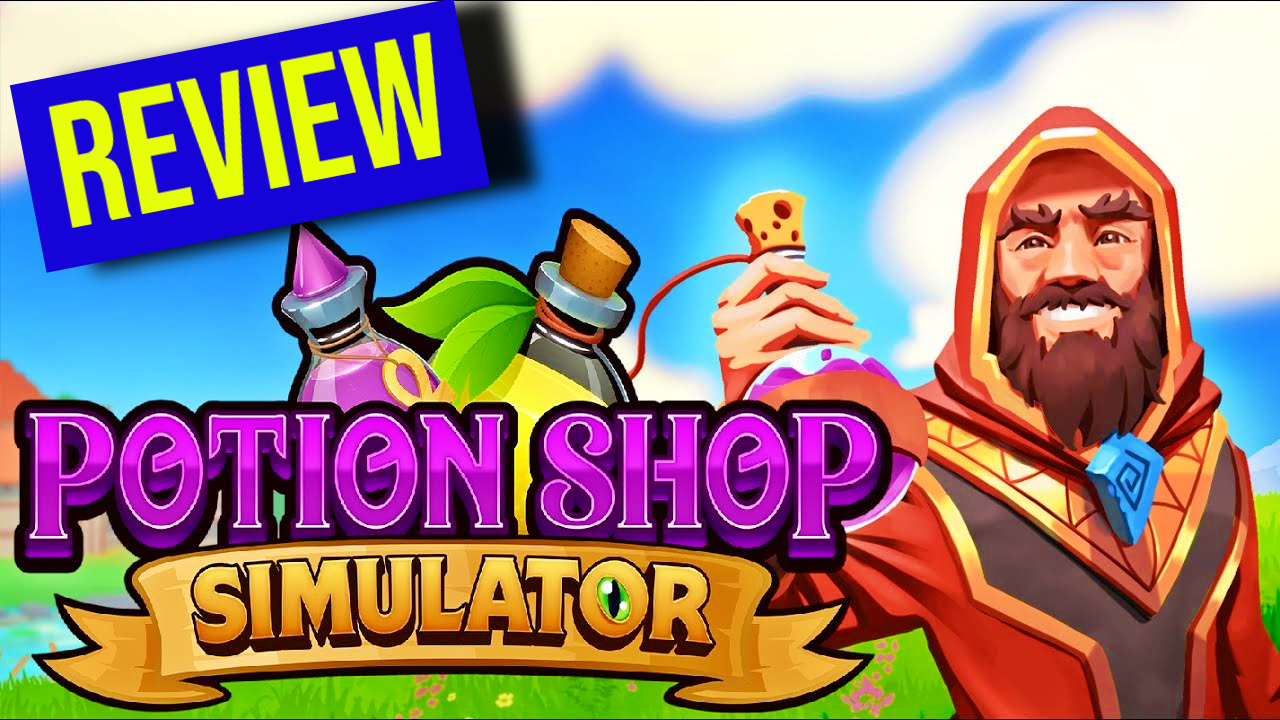
Potion Shop Simulator Review – I’m a Wizard Now
Getting utterly and hopelessly addicted to a game about brewing potions in a fantasy town full of orcs, goblins, and other kinds of scaly creatures was not on my 2025 bingo card – but here we are. Potion Shop Simulator, on the face of it, appears to be like all the other memey simulator games, but when you actually start playing the game, you’ll come to find that not only is the gameplay engrossing, but there’s an intriguing storyline, as well as a boat load of customization and upgrades that you can perform to be the best goshdarn potion shop in fantasyland. And the kicker is that you can play it with friends. So let’s dive deeper into Potion Shop Simulator with our review.
You start your potion-brewing journey as an alchemist early in their career, who takes over an alchemy shop from a man named Wilbur. We don’t really know what happened to Wilbur, and that plays into the game’s central mystery. NPCs make comments about his disappearance and – when you’re ready – you can complete missions to find out more. This acts as the main campaign, but first, let’s talk basics. A little flying dragon thing teaches you the basics of gathering flowers and crafting them into potions. Then he shows you how to put those potions on your store shelves, open the store to sell your goods, then close up shop and count your money. Then, poof, he’s gone, and it’s up to you to run your potion shop.
Your potion shop is located on the outskirts of a medieval fantasy village inhabited by friendly orcs and goblins and dragon-people and more. The basic gameplay loop is to gather the necessary plants, dry them on the drying rack, crush them in the mortar and pestle, then brew them in the cauldron. Wait a few seconds and voila, your potion is ready. Take it downstairs and pop it on a shelf, and when you decide to open up shop, the inhabitants of the village will come in and buy it. Though this is, basically, the gameplay loop, things get far more in-depth than that.
There are 4 elements: water, fire, air, and earth. Each flower or ingredient you add to the cauldron has a certain number of each property. Meadowlark, for example, will add 4 air elements to the cauldron if thrown in as a flower, or 8 if dried out first. To brew a potion, you need to have a certain ratio of each element. So, for example, to brew the Goblin Gut Soother, you need a ratio of 1 fire to 2 air. If you add more ingredients but keep the same ratio, the potion you brew will come out larger, which is helpful because each race of clients who visit your shop prefer different potions in different sizes (goblins ARE very small after all). But how do you know what ratio of ingredients to add to your cauldron? Ah, good question, sir and or madam. You do this by experimentation, of course! Throw a bunch of ingredients into the cauldron and see what happens. And if you hit upon something you haven’t made before, it will add that recipe to your journal.
Speaking of journal, that’s where you can see your potion recipes, any quests you have, and what rank and appeal rating your shop has. Your clientele changes based on how fancy your shop is, so if you add more decorations and upgrade your equipment, people who are willing to spend more will then come to your shop looking for high-quality goods that you can sell for big bucks. There are various stores in the village where you can purchase these upgrades: the alchemist will sell you potted plants so that you don’t have to scavenge for them anymore, increasing your efficiency. The decoration shop sells all kinds of decorations that you can adorn your potion shop with to attract better customers. The woodworker guy will install new upgrades like a greenhouse to increase your space and allow you to have a place for plants that need more humidity and temperature (that’s a thing, by the way. You can’t just stick plants wherever you want.) The equipment shop is perhaps the most important, and this is where you can buy larger cauldrons to make larger potions, or obtain a distiller that will make your potions a higher quality and thus more expensive.

Read how Xbox lost the console war
What’s most notable is that the village feels alive. The game has a proper day-night cycle, and your journal has a calendar that tells you which various events and activities you can complete on which days. You can sell your goods at the market on market day, visit the traveling merchant to buy special materials, prepare for potion shop for its weekly inspection, and more. There are market trends for certain potions, and days that have rush hours mean more frequent customers to your alchemy shop.
The detail that Potion Shop Simulator goes into is what really sells the concept. I mentioned earlier how you dry plants and then crush them, but what I didn’t mention is that you need somewhere to store them. You put your ingredients in jars, but each jar can only have one type of ingredient in it. That means you need to buy more jars as you start obtaining new ingredients. And how do you transfer all these ingredients into their jars? You can painstakingly do it one by one, or you can pick up a crate and do it all at once. And it’s a similar story for putting the potions on shelves. This might sound like a basic concept, but having to load things into boxes and manually move everything around adds to the realism of the game, and means that you really do want to save up for additional watering cans, creates, jars, and all the other little items that help you be more efficient with your time.
And did I mention that you can do all of this in co-op? Potion Shop Simulator is perfectly playable in single player, but you can team up with your friends and run the potion shop together. This means one of you can be on brewing duty, while another goes into town for supplies or gathers flowers, while another one of you sells your wares.

One thing I will say is that I feel like Potion Shop Simulator hasn’t got the marketing it deserves. Screenshots of the game look fairly basic, and you wouldn’t pick it out of a line-up as a game that will blow your socks off, but here we are and it does. The game certainly lacks some polish in its graphics and animations, but nothing more than you’d expect from an indie game. And, frankly, I’d rather play an original game like this that has some flaws than a big budget boring game any day. So, while a trip to the Steam Store might not impress you, trust me when I say that Potion Shop Simulator is far, far better than it looks. Saying that, what’s the verdict? Who should buy Potion Shop Simulator?
Potion Shop Simulator: Potion Shop Simulator blends strategy and simulation in an additive package that will stop you from putting it down, as you convince yourself you need to brew just a few more potions or water the plants in the greenhouse before logging off. Its concept of brewing potions might not be unique in the grand world of video games, but when you add in the fact that you’re serving the denizens of an open-world medieval fantasy village – and that there’s an interesting mystery side plot to follow – Potion Shop Simulator manages to carve out its own original niche. Truth be told, I’m not someone who themselves drawn in by crafting games, but something about Potion Shop Simulator just kept me coming back for more – and that’s despite its unpolished animations and graphics. In that vein, it’s clear that Potion Shop Simulator’s developers didn’t have a huge budget, but they didn’t need one, and what they’ve managed to achieve is nothing short of fantastic. So, if you’re the sort of person who normally finds games like TCG simulator interesting, or you just want to brew some potions in a relaxed atmosphere that has no time constraints, then you’ll almost certainly love your time with Potion Shop Simulator. And the fact that the experience can be played with friends only adds to the fun. – Jesse Gregoire


