
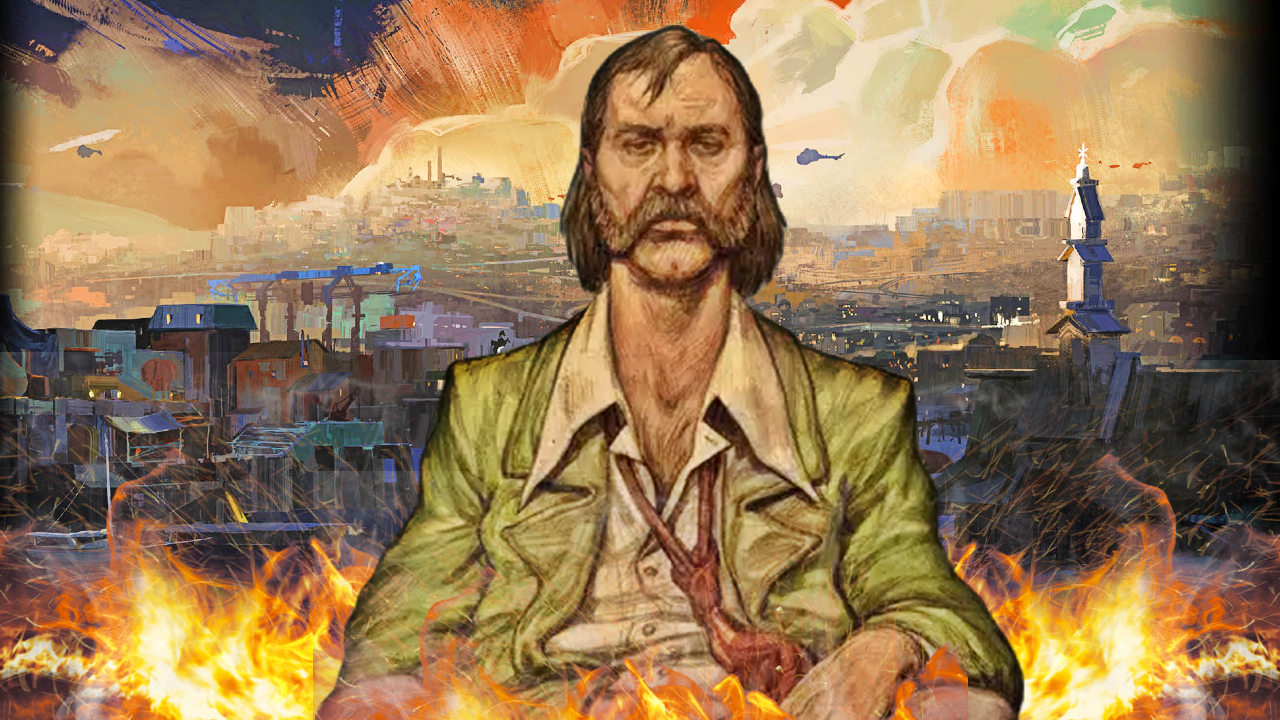
The Tragedy of Disco Elysium and its sequel
In October 2019, I attended EGX in London, one of the largest video game conventions in the country. It was a long day, and I was tired. So, I found a small, out of the way stage where I could rest. Alice Bell of Rock Paper Shotgun was interviewing a man about a new game that had released just a week earlier called Disco Elysium. That man was Robert Kurvitz, the man at the centre of the game’s creation. There were only around 10-15 other people in the audience at the time, and I drifted in and out of listening to him talk about how the game relied on its writing. At the time, we didn’t know that Disco Elysium would go on to be such a huge hit, and it shows how the game went from an almost unknown indie to being heralded as one of the best games ever created in just a short span of time.
The development and downfall of Disco Elysium is one of the most fascinating stories in video games. In a world of flashy graphics and hitmarkers, Disco Elysium was a game made by two recovering alcoholics and relied on writing and static art to create its world. Yet, for all of its success, due to reasons Harry DuBois himself would shake his head in disdain at, the production of a sequel was ended by greedy corporate overlords. So, in this video, we’re going to chart the development of Disco Elysium from concept to release, talk about the controversy that forced Kurvitz to cut ties with the company, and discuss the Disco Elysium book, the possibility of a sequel, and the future of the franchise. This is the sad legacy of Disco Elysium.
The development, release, and reception of Disco Elysium
At the centre of Disco Elysium’s origins is Robert Kurvitz, an Estonian novelist and musician-turned game designer. But our story has an unusual start, because Disco Elysium wasn’t the product of veteran game designers. In fact, the game’s development has its origins way back in the year 2001. That year, Kurvitz joined a band called Ultramelanhool. They played together for a few years until 2005, when Kurvitz and the band were down on their luck and struggling to pay the bills. During a night of drunken debauchery, he came up with base idea for a fictional world full of dystopian revolution; the very fictional world that would comprise Disco Elysium’s Revachol. Excited, Kurvitz and the group decided to create a collective group of artists and musicians to expand upon their ideas from that night to create a tabletop RPG based on Dungeons and Dragons. It was here that Kurvitz met Aleksander Rostov, an oil painter who would eventually become the lead artist on Disco Elysium and be responsible for bringing the game’s beautifully bleak world to life.
During this period, Kurvitz also met fellow Estonian author Kaur Kender, who helped him to write a novel based on the tabletop RPG world he’d just created. The novel was called Sacred and Terrible air and was published in 2013. But the book only sold 1000 copies, which sent Kurvitz into a three-year long period of depression and alcoholism. All his hard work and great ideas failed to find the audience he was looking for. But, as is often the case, this era of struggle would eventually shape his world even more, and it’s no coincidence that, in Disco Elysium, you wake up as an alcoholic amnesiac with no pants. Kurvitz went on to use these experiences to enhance his art when the game was finally released.
But we’re getting ahead of ourselves. When Kurvitz finally pulled himself out of his depression, he and Rostov decided to roll the proverbial dice on their idea one last time, but this time in video game form. They decided that if they were going to go down in flames, it would at least be doing something they loved and felt passionate about. Thus, in 2016, they gathered all the resources they could and work on Disco Elysium began. In true Revachol style, Kurvitz and the team started out their game development journey by living together – well, squatting – in a former art gallery in Tallinn, the capital of Estonia. They were able to secure venture capital for the game, mostly through an Estonian businessman named Margus Linnamae. Remember this name, because it will become extremely important later. Linnamae’s cash injection allowed Kurvitz to hire the band Sea Power, and expand the development team even further. Studio ZAUM had staff located across the world in places like the UK, China, Romania, Poland, and more. The team grew to have 35 in-house developers and 20 freelance consultancy, which also included a team of 8 writers to assist Kurvitz in writing what would end up to be over 1 million lines of dialogue for Disco Elysium.

In an interview with The Escapist Magazine right after the game’s release in 2019, Kurvitz said the founding members of ZAUM are all high school dropouts who had no prior game development experience before working on Disco Elysium. Up until that point, they had spent most of their youth smoking cigarettes, wandering the concrete streets of Eastern Europe, and playing Dungeons & Dragons. It didn’t take long for Kurvitz and friends’s creative side to come out and they started developing their own rules and worlds for thetabletop game. It’s no wonder, then, that the foundations for Disco Elysium would lie in dice rolls and a heavy narrative. Combined with Rostov’s predilection for oil painting, Disco Elysium quickly started to take shape.
Disco Elysium’s story takes place in the seaside district of a fictional city still recovering from a revolution that occurred decades prior to the game’s start. Players take the role of an amnesiac detective who has been tasked with solving a murder right outside his hotel room. During the investigation, he comes to recall events about his own past as well as various forces and factions trying to affect the city. The game features very little combat and most events are resolved through skill checks and dialogue trees. Players can select their protagonists personality traits and skills, and an additional system called the Thought Cabinet represents ideas and ideologies that emerge as you interact with Revachol’s denizens. Players are free to accept or reject these new thoughts, and the outcomes of almost everything in the game can be changed based on these aspects.
From that description of Disco Elysium, it’s easy to see how all of Kurvitz’s previous work, and possibly entire life, came to shape this innovative new game. The saga of this antihero in a dilapidated city would draw influences from games like Planescape: Torment, which, like Disco Elysium, features an amnesiac player character, heavily emphasises dialogue, and is rendered isometrically. The television show The Wire was also used as an influence for the game’s working class setting, along with the poetic delivery of Kentucky Route Zero.
While the title of Disco Elysium might seem random, it plays on a few double meanings. In one sense, it refers to ideas that briefly gain the spotlight before burning out similar to the fad of disco music, which is reflected in the protagonist’s clothing style. In a more literal sense, “disco” is Latin for “I learn”, and it was an intentional reflection on the protagonist overcoming his amnesia to learn about the world of Elysium alongside the player.
But despite gaining financial backing, Studio ZAUM was still an indie developer and the game didn’t have a publisher.The whole project had been a huge gamble, but it was a gamble from the heart; it was an experience born out of passionate and creative necessity. It was a story that NEEDED to be told, not one derived from flow charts and bar graphs in the glass walls of a CEO’s office in the skyscraper of a major publisher.
After many years in development, Disco Elysium was finally released for PC in October 2019. To begin with, the game hardly had any voice acting, and it was up the the player to scroll through the text and read it. Despite this, the reception of the game was amazing, with many reviewers and players hailing the game as among the best games ever created. It still sits at a chart-topping 91 out of 100 on Metacritic, and this choose-your-own-adventure has gained spots on numerous top 100 games of all time lists. To put Disco Elysium’s success into perspective, IGN named it the 10th best game of all time, just one spot behind Half Life 2, which was astonishingly groundbreaking and drove modern gaming forward way back in 2004.

The cherry on the cake came in 2021, when the Final Cut version of Disco Elysium was released. This version of the game was given as a free update to PC players, but it also came to consoles in digital and physical format. It contained new content with subtitles and it was full voice acted. The Final Cut version of Disco Elysium is the ultimate experience. Lead writer Helen Hindpere stated that all the changes were made with direct input from fans. The full voice cast would have to read lines for over 1.2 million words, and their work would cover nearly 100 characters in total. ZAUM kept all of this work in-house to maintain maximum creative control, but that meant it would take 14 months to fully cast the characters and record the voice lines. Kurvitz was adamant about bringing Jazz singer Lenval Brown on board as the key narrator. This would be the best decision the team could have made, as Brown’s subtle, ununciated tones have come to be known as synonymous with the game. The actor spent eight months with the voice directors to record his lines. They worked on keeping his voice constant, slow and meticulous for all of the different characters skills since these were explaining things to the player, but they also included small nuances to try to distinguish the various facets of each skill’s personality.
It’s safe to say that Disco Elysium had evolved to its final form with the release of the Final Cut in 2021. They had perfected the formula and polished the game to be as good as it could, even though it had already been considered among the best games to have ever hit store shelves. So, you would think that with all of this success; with all of the well-detailed lore and genius worldbuilding the team did, that a sequel was a no-brainer. And this is where the story gets complicated, and takes a nasty, controversial turn. Because we could have been playing Disco Elysium 2 right now. We could have been Jamrock shuffling in our horrific necktie again.
The Disco Elysium Controversy
Everything was going far too well for the original Disco Elysium creators. They’d seen unprecedented indie game success, and Kurvitz’s ideas had finally been vindicated with the help of Rostov’s gorgeous oil painting art. All those years of toil and rejection had paid off. But it wasn’t to last. Remember earlier when we mentioned Margus Linnamäe, the Estonian businessman who fronted the money for the development of the game? In 2021, Estonian company Tütreke OÜ bought out Linnamae’s original shares in the company. According to a Medium post by Kurvitz and Rostov, Once this new company had gained a majority share, things began to change. The pair were quickly excluded from daily operations at ZAUM, their employment was terminated, and their access to the company’s information was shut off. Then, weeks later, the Kurvitz and Rostov, the original masterminds behind Disco Elysium and ZAUM, were fired.
After spending 5 years working on Disco Elysium, not knowing whether they were going to be met with terrible reviews and poor sales at the end of it, Rostov and Kurvitz were cut off from what they call their life’s work. We won’t go into the entire legal saga here because People Make Games have a video on this if you want more detail, but regardless of who is right and who is wrong, there’s one fact we can’t escape: the world of Disco Elysium and its fans are the ones who suffer. Kurvitz and Rostov were crucial pillars of bringing Revachol and Harry DuBois to life, and with them now out of the picture, it’s difficult to imagine a world where all of the key players patch things up, put their differences aside, and focus on bringing us a sequel to one of the best games of all time. And that’s exactly what was supposed to have happened – we were supposed to be playing Disco Elysium 2 right now.

Disco Elysium 2
See, it seems that even all the way back in 2019, Kurvitz had planned not just a sequel but a whole franchise based around the world of Disco Elysium. He told the Escapist that there was an insanely ambitious list of projects they wanted to make using the Elysium setting. This would culminate in around 20 years time with a fully fleshed out tabletop pen and paper RPG called You Are Vapor. You might think that Kurvitz and Rostov being fired from the company would put an end to any of these plans – but it didn’t. In fact, ZAUM was still developing what was described as “a spin-off about one of the most beloved characters in Disco Elysium” that was a full-sized game that would take place in an entirely new setting. More than likely this game would follow fan-favourite RCM police officer Kim Kitsuragi. An internal demo of Disco Elysium 2 – which was still being written by one of the lead writers on the first game, Argo Tuulik – was shown at ZAUM at the end of 2023 and purportedly wowed the team who witnessed it. This sequel could have been ready as early as 2025. So, despite all of the controversy, it seems fans were still in for a great experience with the follow up to Disco Elysium. But it wasn’t meant to be.
In February of 2024, Tuulik and a quarter of ZAUM Studio were laid off by management. Tuulik told PC Gamer that he was leading the charge on the Disco Elysium sequel. According to other staff members, the game would have “advanced the story, the emotional threads, and gameplay elements all at once to truly evolve the genre of psychological RPG as Disco Elysium started it.”
This new project – which we’ll call Disco Elysium 2 to keep it simple – would have been hitting out hard drives in 2024 or 2025 according to the developers who were fired. They had put the controversy behind them (or so they thought) and were making strides in development to make Disco Elysium 2 the best experience it could be for the fans. But development was soon plagued by organisational issues and frustrations from the shareholder takeover were still an issue. Tuulik and his colleagues felt like they’d been sidelined by management. Meetings were cancelled, communication was stopped, and things at ZAUM were very strange indeed. This was the atmosphere until February 2024, when, despite management telling them just months before that ZAUM was in a good place financially, Tuulik and 25% of his closest colleagues, all working on this Disco Elysium follow up, were laid off. Along with their firing, their Disco Elysium follow up was cancelled, even though it was so close to release. Why was Disco Elysium 2 cancelled? Nobody knows. But the team who was working on it had nothing but love for the world they had created and wanted to give their audience more of what we wanted. Now, it seems like that won’t happen.

The Tragedy of Disco Elysium and its sad legacy
In 2019 and 2020, Disco Elysium won a plethora of awards at the Game Awards and BAFTAs. When the team took to Geoff Keighley’s Game Awards stage, they gave a shout out to Marx and Engels, to political theorists and philosophers that influenced their work on Disco Elysium. It’s a game with overtones of social hierarchy, classism, and capitalism after all. Ironically, the the satirical events that have occurred at ZAUM just go to highlight exactly what Disco Elysium is about. In a haunting, upside down version of events, the firing of Kurvitz, Rostov, and team working on Disco Elysium 2 and its cancellation hold a mirror up to the fact that it’s difficult to separate the art from the artist. These individuals gave over five years of their lives to creating the world of Disco Elysium and its sequel to please their fans; to show the world that smart ideas and poor indie developers could make art directly for their fans, without the interference of greedy corporate overlords who only loved money. The real tragedy of Disco Elysium is that despite everyone’s best efforts, that’s exactly what happened at ZAUM.
By all metrics, Disco Elysium was a monumental hit. It wasn’t supposed to happen. Or at least it wasn’t likely that a failed writer and his oil painting friend with no game development experience could bring together a team that – with very little backing – created a game that sits right after Half Life 2 as one of the best games of all time. But they did it. And after all of this success, all we, as fans, wanted was more. More games set in the world of Elysium. More role playing, more dice rolls, more Harry and Kim. Instead, the people behind the game got fired. Then, for some reason, the remnants of the original team that were still making a sequel were fired. It was a move that made no sense then and continues to make no sense, even from a purely financial point of view. But what’s worse is the sad legacy of the Disco Elysium franchise. We were supposed to be enjoying decades of video games, tabletop games, and who knows what else set in this addictively bleak and dystopian world that had a lot to say about how we live our lives. But now the ideas, concepts, and experiences are instead doomed to decay like Revachol itself despite everyone’s best efforts. And that’s the real tragedy of Disco Elysium. That it was a project brought down by the very people it rails against in its narrative, and that we’ll never get to explore this great world again.
Find out why the Xbox experiment has failed.


