
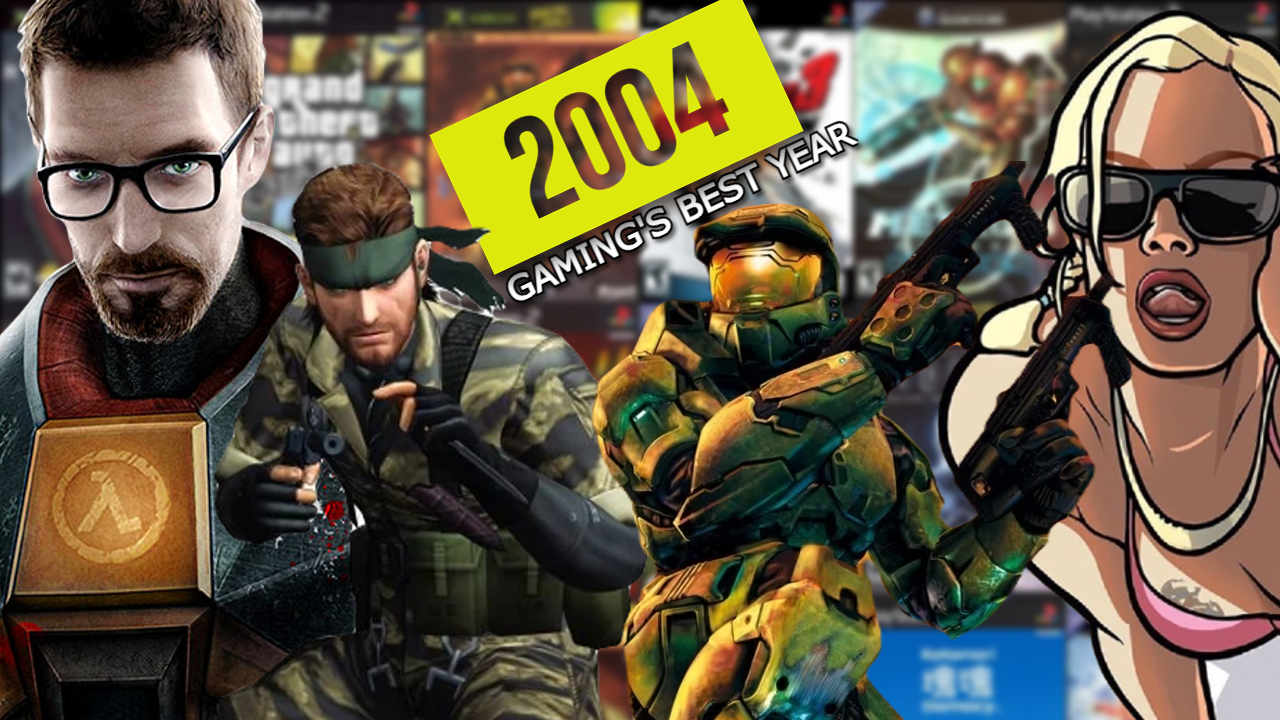
The Best Year in Gaming History – 2004
The topic of the best video games comes up often. Maybe you’re out with your friends and you end up arguing about your favourite games and when they came out. Or maybe you’re just sitting in a dissociated nostalgia gaze, remembering times gone by and all the great consoles you played as a kid. And hey, I’m not judging, because I too get remember fondly that time the PS2 came out and my friends and I stayed up playing metal gear solid 2 all night. But what usually follows these kinds of thoughts and conversations is one question: when was the best time to be a gamer? While researching for a recent video on Guerrilla Games’ forgotten Vietnam game, Shellshock Nam 67, I came to the realization that the undisputed best year in gaming was 2004. So, we’re going to dive deep into the games of 2004, and discover why it was – and likely will remain – unmatched.
Setting the scene, context, and what consoles were out
Before we jump into all the amazing games that came out in 2004, we first need to set the stage. 20 years ago, the gaming landscape looked far different than it does today. Even the biggest games that came out at the time had vastly smaller budgets than they do today, and it was common for games to be developed by small teams. To give you context for this, 2004’s GTA San Andreas had a budget of under 10 million dollars, while the latest game in the series, gta 5, had a budget of 265 million dollars. Gaming certainly wasn’t the cash cow it is today, and in fact, it was still quite a niche interest that hadn’t broken through into popular culture.
The major consoles out in 2004 were the PlayStation 2, the original Xbox, and the Nintendo GameCube. All of these consoles had launched in a one-year window from 2000 to 2001, and this is one of the key reasons that 2004 ended up being the best year in gaming. Let me explain.
By 2004, these consoles had been out for around 3 to 4 years and were at the midpoint of their lifespan. Their successors – the ps3, wii and 360, were still around 2 years from release. This meant that game developers had already been using and getting experience with developing games for the various platforms, and subsequently, games were starting to get bigger, more beautiful, and more ambitious at this stage of the console generation. This is important, because consoles back then all ran on proprietary software that was tied to their own systems, which is one reason we saw far more exclusives than we do today. It was simply a lot more work for developers to release their games on multiple different platforms. This is a far cry from today, where most consoles run architecture very similar to PC and thus it’s easy to port games to all platforms.
What we also need to keep in mind when talking about this period of gaming is that video game developers and players were still figuring out what gaming would look like in the future. While Sony was ahead of the curve with their DualShock controller with dual sticks right from the beginning, controllers had been largely d-pad and three button affairs. The GameCube controller only had one normal thumbstick combined with a mini nub, and the Duke Xbox controller was humongous and its R1 and L1 buttons were two of the tiniest black and white buttons in the most inconvenient place ever. And while the Xbox utilized a hard drive, the ps2 and gamecube still used memory cards. This was also the first generation to really push the graphical power envelope forward. So, in these examples, we can see that while things might have been in a state of flux, the big 3 game makers were starting to understand what gamers actually wanted from their consoles. That also meant a focus on longer, more graphically intensive and cinematic video games. We were tired of looking at the Playstation 1’s handful of muddy polygons and we wanted more. Thankfully, 2004 came along to give us what we wanted in spades.
The games
We can’t possibly cover every single game that came out that year, but we will be covering the most significant releases of 2004. So let’s dive into the most significant games that came out in that year, then we’ll discuss why they matter, and how the whole context of what was happening in video games that year coalesces into making 2004 the best year in gaming history.

Let’s start with the obvious, Grand Theft Auto San Andreas. This was the first GTA game to really cement the series in pop culture. GTA 3 and Vice City were the first 3D games and had their own striking personality, but San Andreas took things to the next level. Never before had console games offered so much freedom and exploration. You could visit 3 different cities across a vast game map, and it had a great story that had characters voice acted by the likes of Samuel L Jackson. And it was all created with a budget the fraction of the size that modern Rockstar Games get. San Andreas is the game that many think of when we talk about 2004, but there are tons of games that we shouldn’t forget to talk about.
Halo 2 is another big hitter from that year. We didn’t know it at the time, but Halo 2 would end up being the quintessential halo game; the game we all think about in our mind when we talk about the Halo series. Unusually for a sequel, it ended up being bigger and better than the original game. The graphics were a marked improvement. The story was engaging and left us all on a cliffhanger, begging for Halo 3. And Halo 2 improved on Combat Evolved’s multiplayer, which pioneered the way we play games in the early days of Xbox Live and online console gaming.
We can’t talk about games of 2004 without mentioning the king of PC gaming – Half Life 2. This sequel to Valve’s groundbreaking Half Life came 6 years later and was an unbelievable triumph. Half Life 2 pushed the boundaries of gaming limits to new levels by introducing things we didn’t even believe possible. It had beautiful graphics, it had a physics system that allowed everything in the game to move around, and it broke so much new ground that we still talk about it and use it as a baseline today. But it wasn’t all about the game. Half Life 2 required players to install the Steam platform on their computers. Back in those days it had an olive green UI, and you could play and buy Valve games all in one place. What we didn’t realise at the time was how it would bring PC gamers together again with its community features and friends list. In 2004, PC gaming was kind of unpopular and most mainstream gamers were picking up consoles, but Half Life 2 and Steam changed all of that and saved PC gaming.
Next up, we need to talk about World of Warcraft. There were other MMOs that came out before WOW, namely games like Everquest, but 2004’s World of Warcraft was the first prominent MMO to take the world by storm. Building on RTS Warcraft lore, World of Warcraft even sparked the famous South Park episode just 2 years later. Again, it’s another 2004 game that permeated the pop culture zeitgeist and paved the way for all the modern MMOs we’ve come to know and love today.
Yet another huge 2004 release was Metal Gear Solid 3 Snake Eater. Heralded by many as the best Metal Gear Solid game of all time, Snake Eater introduced a boat load of new mechanics and carved out a unique identity for itself. The game was a quick follow to 2001’s MGS2, which itself took the series forward with things like first-person shooting. Even so, Snake Eater managed to surpass it by adding game mechanics like being able to change your camouflage or scavenge and hunt animals for food. Snake Eater is the perfect example of what a developer can do when they learn the architecture of a console mid-generation. The game also had an amazing story and oozed awesome cold war style.

You might know Far Cry as the Ubisoft game that has you climbing towers and wreaking havoc across a huge map, but it all started with the original game in 2004. It took a lot of cues from Lost and had you scouring a tropical island for a missing journalist. You mainly fight bad guys to begin with, but it all turns a bit sci-fi towards the end. It’s the game that sparked a 20 year series that ubisoft is still crapping out today, but the best part is that it doesn’t have any towers to climb.
So far, we’ve seen how 2004 was a year of innovation, where game developers tried new things. One of the best examples of this that we often overlook is Doom 3. At the time, many were confused because the first two Doom games had been adrenalin-fueled demon hunts, but Doom 3 took a new approach. It was slower and more horror based, and it had graphics that pushed even the most powerful PC at the time to its limits. Looking back now, it was scary, beautiful, and did I mention scary? It dragged first person horror shooters into the 21st century kicking and screaming, and the likes of Doom Eternal wouldn’t be possible without it. Doom 3 demonstrated what modern horror audiences wanted.
Star Wars Knights of the Old Republic 2 is a role playing game that everyone still talks about today. It’s a series that has some of the craziest plot twists and stories in gaming, but it’s also the first time it felt like a developer did something significant with the Star Wars licence. It’s a long game – around 30 hours – and that was huge back in 2004. We got to live out our Jedi fantasies in a true role playing game with choices, so it’s no wonder we consider it up there with the greatest games of all time.
Splinter Cell: Pandora Tomorrow was the sequel to 2002’s Splinter Cell. We’re back with Sam Fisher on a new mission, and this time around Pandora Tomorrow brought us huge quality of life improvements over the original. The levels were more varied and interesting, and it only adds to the fact that 2004 was a bumper year for video games. That reminds me, how did we actually afford all of these games? Does anyone remember? Maybe that’s why I’m poor now.
Just in case this list wasn’t long enough, Red Dead Revolver also kicked down our doors in 2004 and demanded that we buy it. It’s the first entry in the Red Dead series and doesn’t get anywhere near the attention of Red Dead Redemption. Revolver unwittingly sparked a cowboy obssession for the whole of the gaming world and the game laid the foundations for what is now a series that rivals GTA in popularity. It innovated in the gunslinging bullet time department and pioneered the open world, cowboy wrangling exploration we still love today.
Can you believe that Killzone of all games came out way back in the depths of 2004? Killzone was one of the first FPS games set in the future that asked you to fight off hordes of space fascists. It was one of the few first person shooters to take a more mature approach to its story, and the game more realistic weapon and movement mechanics than we were used to at the time. Of course, it spawned many more games over the years, but the original was revolutionary when it came out and just added to the madness of 2004.

Something that came completely out of left field that year was Vampire the Masquarade Bloodlines. The game became a cult hit and is still loved by its die-hard fanbase today. Bloodlines took the world of the role playing tabletop RPG and transplanted it into a videogame. You can create your character from the ground up. You select what type of vampire you’re going to be, their background and history, and then you spend the game role playing as them. Your choices matter and Bloodlines has some wild story missions. It has spawned countless mods, and despite being janky by modern standards, the community is still strong around Bloodlines.
And, finally, to bring us to the end of the most significant game releases of 2004, we have to talk about the trend in Vietnam War games around that time that led to many of them releasing at the same time. In 2004 alone, we were treated to Shellshock Nam 67, Battlefield Vietnam, Conflict Vietnam, and Men of Valor. They’re all too similar to go through in detail one by one, but they all followed similar themes: shooters that sent us into the jungles of south-east asia to fight vietcong guerrillas. These games varied in quality, but it was good to see shooters take a new approach and deliver some more mature themes and stories into our games, which is something that we’ve lost today.
So, those were the main heavy hitters, but we also got a plethora of other innovative games in 2004. This includes: The Sims 2, Need for Speed: Underground 2, Fable, Rome Total War, Hitman Contracts, Paper Mario The Thousand Year Door, The Chronicles of Riddick, Unreal Tournament 2004, Katamari Damacy, Jak 3, Ratchet & Clank: Up Your Arsenal, Silent Hill 4, Def Jam: Fight for NY, Tony Hawk’s Underground 2, and Gran Turismo 4. I’m likely missing quite a few games out of this list, too.
But, with all of these games mentioned, we can see a pattern emerging. 2004 was a year where game developers, studios, and publishers took risks. They brought us new IPs full of new ideas and new gameplay mechanics. We saw the rise of mid-budget games, which we sadly don’t see anymore. Games in 2004 had far lower budgets and smaller teams, but the quality of their ideas and execution remains unrivalled. Yes, games may look better now, but Ubisoft’s approach is largely representative of the majority: if developers can’t show higher ups that their idea has been done before and made lots of money, it doesn’t get made. And that stagnates creativity. Which brings me to why 2004 was such an important year for games, and why it all matters.
Why 2004 was so important
We’ve gone through the gigantic range of hit games that came out in 2004, but the games themselves were not solely what makes that year the best in gaming history. Part of the reason 2004 was, and still is, important is that it cemented how games would be made for decades to come. It was a year that paved the way for today’s gaming landscape. When you think of the games we just mentioned, you think of them as modern games, or at very least you could pick up a controller and play them – you would be familiar with the controls. But 2004 was the year that everything in video games started to come together and be standardised. For example, before then, FPS console games didn’t necessarily follow the twin stick shooter concept as standard. Games like Halo had come out and utilized the left stick to move and right stick to aim, but it took the multitude of shooters in 2004 for the industry to realise that’s how things should be done as standard. Hardware was also started to standardise; the xbox had a hard drive and Xbox Live was getting more and more popular with the release of Halo 2, which allowed players to matchmake, join lobbies, and form clans. The sheer number of hit games that spanned almost every genre showed developers developers and publishers what we actually wanted to play and set a precedent for what games would be created in the future.
We also have to look at the whole industry in context and what else was going on outside of the games. 2004 really marked the first time that 3D graphical technology in both consoles and PCs had gotten powerful enough to create huge worlds, cinematic cutscenes, and realistic-for-the-time gameplay. As we discovered earlier, it was far enough into the console generation that developers had started to work out the kinks in developing for these platforms and really started to push consoles to their limits.
On top of that, the Nintendo DS also launched in 2004. It brought us a wildly new take on handheld gaming and showed us what the future looked like. Previously, Nintendo had only created handhelds in the GameBoy line up, which were basically watered down, mobile versions of NES and SNES games, or at least their concepts and quality were. Handheld games had largely been top-down or side-scrolling pixel art affairs up until that point, but the Nintendo DS changed all of that. It had two screens, one of which was a touch screen that you could use the supplied stylus to directly interact with. Because of this, it allowed for new types of games of games to be made, like Ace Attorney and Professor Layton. The Nintendo DS eventually birthed the 3DS and Switch, and Nintendo would look very different today if 2004 hadn’t come along and introduced all of these fresh new ways to play games.

Why we’ll never see another year like 2004
Unfortunately, it’s unlikely that we’ll ever see another year like 2004. It was a unique time in gaming history that bridged the gap between the more unrefined years that preceded it with the more modern gaming we know today that came after. Games didn’t need the huge Hollywood budget that they have today, and because of that, they didn’t need to answer to groups of investors. Creativity was king, not all out profit. It was a time where developers tried new ideas and avenues of approach. Some of these approaches – as was the case with Shellshock nam 67 – didn’t work out, but many of them did. We got a Star Wars game that doubled down on RPG elements because developers realised we wanted to live IN the universe and not just watch it. Which was the same reason San Andreas and its RPG-like mechanics became so popular, combined with how large and varied the game world was. World of Warcraft showed that we wanted to live a whole other life inside our MMOs. Doom realised that we wanted more than just fast-paced shooting; we wanted an atmosphere of dread and to have an actual reason to fight Hell’s demons. Vampire the Masquarade Bloodlines understood that fans wanted to create their own vampire from the ground up and live out a dark, urban fantasy story. Snake Eater gave us more character development around Snake, Big Boss, and the series’s lore, while also introducing new mechanics and a completely new style of play. And Killzone’s success exemplified how we don’t want our shooters to be mindless; we want a gripping story and to face down evil space bad guys with purpose.
This period of evolution wasn’t just limited to games though. Nintendo took a chance on the DS and its quirky new hardware, Microsoft doubled down on pushing Xbox Live and online gaming in the console sphere, and both developers and players realised what audiences wanted and how they could deliver it. With today’s focus on live-service games that never end and video game company’s focus on profits, we’ve come a long way from the creativity and innovation of 2004. Publishers now churn out the same kinds of games to meet this profit targets, and it’s largely up to indie developers to create games with passion that push the boundaries of gaming and tell nuanced stories that can’t be told anywhere else. Simply look at Disco Elysium, for example, where the game is told through beautiful music, stylised graphics, and written text.
So, with all of that said, this is why 2004 was the best year in gaming history. It gave us an unrivalled number of quality games. It gave us new hardware, ideas, and concepts. It cemented a standardised version of how we play games and the methods for doing so. And it carved out what modern gaming was and would go on to be. We’re still seeing the effects of 2004 20 years later.
What was your favourite game of 2004? What was your favourite console of 2004? Were you even alive in 2004?
You know what game also came out in 2004? The game Guerrilla Games wants to bury.


