
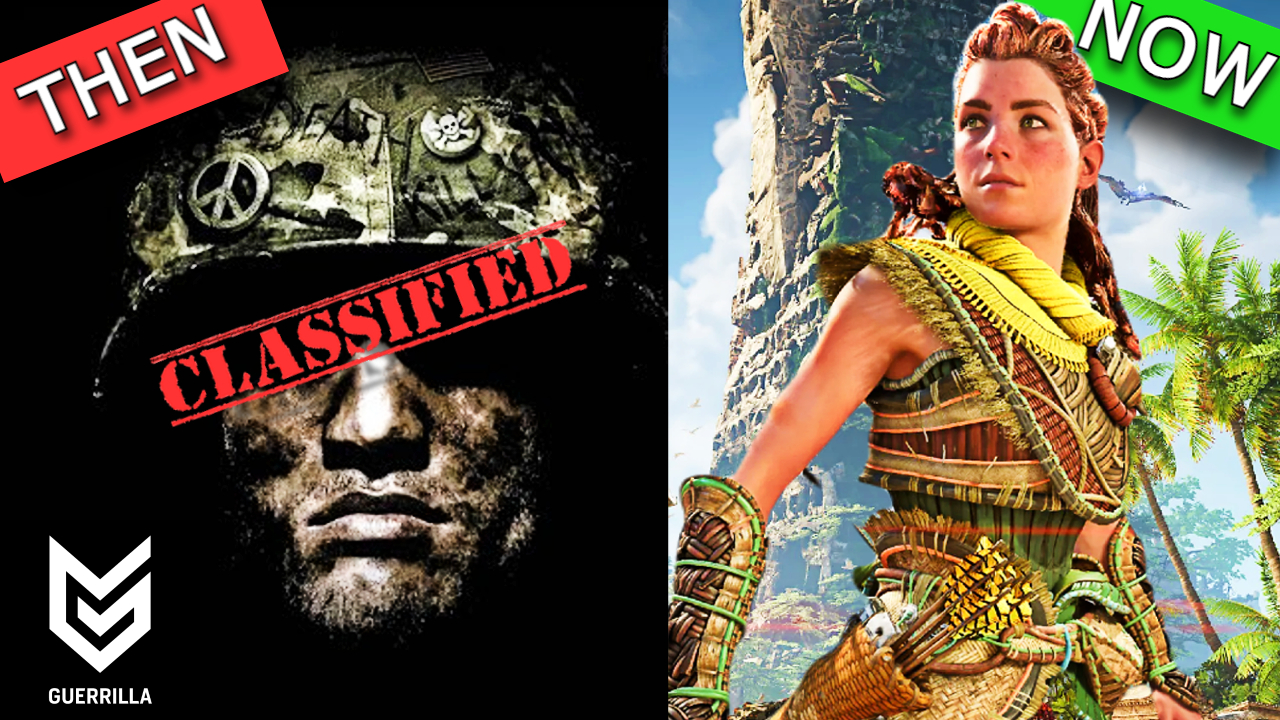
Shellshock Nam 67 – The Game Guerrilla Wanted to Bury
The jungles of Vietnam are hot, humid, and dangerously pixelated in 480p resolution. The noise of the unseen animals is deafening, and I don’t know which pixel is the enemy shooting at me. The controls are terrible, and booby traps annihilate my cheesily voice acted squad mates one at a time. When we do get some downtime at the army base, I wasn’t expecting to be offered racially insensitive boom-boom to break the fatigue of finding Victor Charles’es’ weapon cache’s poorly hidden in haystacks.
This is Shellshock Nam 67, a game that has been erased from almost every store on the internet. Why? Because it was made not only by Guerrilla Games but by some of the same developers who are now still developing games at the studio that makes the more family friendly Horizon games under the auspices of Sony. And boy do they want to sweep this one under the rug, folks.
We’re going to dive deep into the controversial Shellshock Nam 67, find out where its developers are now (hint: at the very top of Guerrilla Games), and talk about just how and why this game has been erased from internet history so that it doesn’t stain Sony’s reputation today.
Our story starts in 2004, the year Shellshock Nam 67 released. The build up to this game had been long and the Vietnam war shooter had been pegged as a gruesome, warts and all portrayal of the asian conflict in the gaming media at the time. There was no shortage of screenshots of missing limbs and soldiers stick in punji stick traps in the games marketing to really hammer home what they were going for. Shellshock was developed by Guerrilla Games and published by Eidos Interactive for PC, PlayStation 2, and Xbox.
A cursory glance at the game’s wiki will tell you that the game was received poorly when it eventually came out. Edge gaveit 4/10, GameSpot gave it 5.4 out of 10, and PC Gamer slapped a terrible 15% out of 100 on it. IGN even called the game “tasteless” for its stereotypical portrayal of, well, everything. It’s not all bad though and there are some amazing features Shellshock brings to the table, but more on that later.
Two weeks before the game’s release, the lead character artist on the game took to GameSpot to write a developer diary explaining some of the features of the game. That lead character artist was no other than Mathijs de Jonge of Guerrilla Games. Side note: this was before GameSpot was super professional and games journalism was in its infancy, but it’s fascinating that we have this relic still available on the internet.

If De Jonge’s name sounds familiar to you, that’s because it is. De Jonge, and I’m likely butchering this poor Dutch man’s name, is still at Guerrilla Games today, working as a game director for all their latest games, including numerous Killzones as well as Horizon Zero Dawn and Forbidden West.
In the article, aside from the usual guff about all the fancy research they did, De Jong explained what he called the “body parts system” of asset creation. Rather than creating a single mesh model, the Guerrilla team scripted their work so they could swap body parts to make unique characters, which was a novel feature in 2004. Also novel in 2004 was the fact that these body parts could be blown off for added authenticity. Nothing says war like popping a viet cong’s bamboo hat with your rifle, after all.
Another notable name that worked on Shellshock Nam 67 is Jorrit Rouwe, who is today the lead game tech programmer for Guerrilla Games and works as the lead programmer on the game. Like De Jonge, he joined the studio early when it was just a few guys in a room and remains at the head of a now global studio supported by Sony. And like De Jonge, he led the development for numerous Killzone games as well as both Horizon games too. A fun easter egg fact is that Rouwe is in shellshock as an NPC. When you reach the fortress level, he is an American soldier imprisoned in the basement and you can see his name above his head.
This game was a fairly big deal back in the day, and knowing that two of the lead developers on the game still head up Guerrilla Games, I was intrigued how they got from this controversial and poorly received vietnam war story to making trendsetters like Horizon. Was it really that bad, I thought? So I went back to play the game and find out for once and for all. But before I could do that, I had to actually find the game, because it isn’t on any of the major online stores.
First I tried Steam, because I was sure at one point it had been on there, but now there’s no mention of it. So my second stop was to GOG – they’d certainly have it because they’re dedicated to older games, but it’s not on there either. I found out that theoriginal Xbox game was backwards compatible on the Xbox 360, but that hadn’t carried over to the Xbox One or Series X. Long story short, the best way to play this game is actually on PS2 or original Xbox because the PC port is dog doo doo and doesn’t run on modern computers. So, with my totally legal ps2 version in hand, I was even more intrigued t o start playing Shellshock – I couldn’t stop thinking about what in the world are they were trying to hide.
Immediately upon loading up the game, the intro cutscene tells you what kind of game this is going to be. You land in Vietnam aboard a plane and are immediately told by an officer to board a helicopter. This is where he starts briefing you for your first mission, except you can’t really hear what he’s saying over the sound of the door gunner constantly shooting – at what, you might ask? I’m not too sure. Within 30 seconds, you’re already on the ground with a squad and tackling your first mission. I’m sure this is supposed to be some kind of commentary on the Vietnam war and soldiers being cannon fodder and all that grand stuff, but really it’s just jarring.

The first level of the game immediately highlights just why Shellshock was received so poorly. The controls are bizarre. You have to hold L1 to run sprint forward, you hold L2 to lay down but you have to hold it, you press triangle to crouch, and you hold R2 to swap between weapons. Encountering your first vietcong combatants also reminds you of the fact that this game is definitely from 2004 because the aiming reticle is laggy and slow to respond to your thumbstick inputs – thankfully, there’s auto aim and boy will you need it. The character animations are also very rigid and clunky, which takes away the immersion. At first, I put this down to the game’s age and gave it some leeway, but then I realised that Halo 2 had come out around this time too, and that’s a FAR more polished game, so I decided to look up what other games came out in 2004 to see how Shellshock stacks up against the competition, and I was shocked. In 2004, some of the best games to ever come out were released. This includes Half Life 2, Halo 2, Far Cry, Red Dead Revolver, Metal Gear Solid 3 Snake Eater, and GTA San Andreas, just to name a few. With that in mind, it’s clear to see that even for for a 20 year old game, Shellshock falls behind what we expected at the time.
During the first mission of Guerrilla’s gritty Vietnam war game, it’s not long before you start to encounter some of the more mature themes this game is known for. Heads explode, limbs get blown off, and you’ll find yourself having to take down women enemies in black pyjamas. Overall, it took under 30 minutes for me to complete the first mission of the game. It is at this point that you get transported back to an army base, which acts as a kind of mission hub for the game and is what will happen after you complete every mission.
The quintessential Vietnam firebase comes with everything you’d expect: nurses looking after wounded soldiers accompanied by a ghostly soundtrack, a firing range that has weapons simple thrown in the mud as all good marines should do, and a racially insensitive brothel owner who desperately wants you to spend some chits to go boom-boom with her girls. Oh, and don’t forget the terribly voice acted characters that stand eerily around the camp, including Steve Blum of Cowboy Bebop fame.
I had my priorities in order, so I used my available chits to buy the gate pass that allowed me to visit mama-san’s finest boom boom girls… for science of course. I had my pick of questionably racist of local women for boom boom. It was a difficult decision, but I chose the one with the motorcycle because she seemed more up market – if she can afford a motorcycle, I might not contract a nasty disease. But she was too expensive. In fact all of the girls were. I’d been duped because I’d only bought the R&R pass that gave me entry and I needed more funds to actually purchase their services.
I’ve mentioned chits and buying things a lot, so let me explain. During Shellshock’s missions, you can loot various war trophies. Sometimes those trophies are uniform regalia from a dead NVA, sometimes it’s communist propoganda or flags. Each of these grim and morbid collectables translates into what the game calls “chits” when you finish a mission and head back to base to pay for services like boom boom.
As you progress, more weapons are available at the firing range, and you can choose what to take into battle. At first it’s a simple world war 2 grease gun or m14 rifle, but then you unlock more weapons, like a completely anachronistic 30 round m16 with burst capability. You can also talk to various people around the camp before leaving on your next mission too.

If you’re starting to get the impression that Shellshock Nam 67 has a weird identity as a game, that’s because it does. In some respects, you have to applaude the fact that Guerrilla was trying something new and not shying away from the darker side of the conflict. But in other respects, they seem to take it all slightly too far, to the point where the game because a caricature of itself by introducing stereotypes that were entirely inappropriate even in 2004. In short, it’s no wonder that Sony and Guerrilla have tried to bury the game deep down where no one will be able to find out that the people who made this are still at the company, helping to make Sony’s sanitised exclusives.
I’ve done an awful lot of criticising Shellshock so far, but when you start to look past some of the simplistic floors that made it a very janky game even 20 years ago, you start to realize that there are things that shellshock does or pioneered back then that were a lot better than the competition at the time, which includes Conflict Vietnam that launched the same year. For example, the use of undulating and varied terrain and vegetation, which allows you to take cover, jump into trenches and flank your enemies. In a lot of circumstances, the enemy AI will try to flank you or aggressively move forward. These aren’t enemies who just sit back as cannon fodder until you pass a checkpoint like in call the duty.
Despite the game’s cheesyness and stereotypes, there aren’t really any Vietnam war games that capture the immersion aspect of the conflict as well as Shellshock Nam 67. In one early mission, you’re patrolling a rice paddy with your team when the vietcong ambush you. You have to fight your way from cover to cover and use grenades to dislodge the enemy soldiers. It feels realistic, especially combined with the gore system that sends arms and legs flying when you throw a grenade into a machine gun position. In a later level, you’ll fight through claustraphobic tunnels and bunkers too, and while by today’s standards the aiming and movement feels clunky, it’s still surprisingly realistic.
This realistic immersion stretches to the booby traps your team will encounter when patrolling through the jungle, and Shellshock shows the differencebetween the vietcong guerrillas and the North Vietnamese Army, who had different fighting styles. There’s nothing more bone chilling than a whistle sounding and having waves of enemies come through the trees trying to overwhelm you. In some ways, Shellshock is simply unrivalled in its realism and immersion, but it’s at odds with itself; it’s a game that throws tasteless stereotypes at you when you talk to NPCs, and the game’s budget was clearly low in comparison to the other hit games of the day. It feels like the developers watched every Vietnam war movie that was out and decided to cram in as many tropes as possible. Yet, strangely, in its moment-to-moment gameplay, the authenticity of combat and atmosphere let Shellshock Nam 67 punch well above its weight with more ferocity than it deserves.
Shellshock Nam 67 is not a long game, with How Long to Beat placings its average length at around 5 hours. Throughout the dark journey, you’ll progress from new grunt to special forces soldier and take part in some of the most prominent events of the Vietnam War. From what I’ve said already, you can probably guess that Shellshock is a whistlestop tour of all the wacky cliches that the conflict is known for, but it’s an experience that shooter fans should have. One minute you’ll find yourself laughing at how something so offensive ever got made, and the next you’ll be quietly impressed with how tense things can get when you’re just feet away from victor charles. Of course, since Guerrilla Games and PlayStation eradicated it from the internet on PC, and the PC version crashes a lot anyway, you’ll have to find a disc copy on PlayStation 2 or Xbox nudge nudge wink wink and play it that way.
If you’re anything like me, you’ll also be shocked at how two of the head members of Guerrilla Games were responsible for making a game like this, and it’s interesting to see how Rouwe and De Jong progressed from Shellshock Nam 67, to Killzone, to the Horizon Games. In a way, Shellshock is the genesis of their later projects. One thing Guerrilla Games has always done is innovate in actual game design and technology, and that can be seen in the body parts system, where not only can limbs fly every which way but it allows for many characters on-screen to look different simply by randomising their appearance.
For good or bad, you could never make Shellshock Nam 67 today, not just because it’s incredibly offensive but because it’s a low budget shooter that doesn’t have all the glitz and galamour of something like halo 2 or it’s big brother killzone, which also launched in 2004 and was made by a separate team. Shellshock’s developers were very much the B-team at the time, but Rouwe and De Jong proved that Shellshock is far more than the sum of its parts, and that’s evidenced in the fact that 20 years later, they’ve taken Guerrilla Games to the very pinnacle of the video games industry. So, it’s no wonder that now they’re at the top and partnered with Sony, it’s probably best for all involved if they sweep Shellshock Nam 67 under the rug and not draw attention to their not-so-polished origins. It would make sense for Sony to want to de-list the game from online stores too given its content, but at this point, it’s sheer conjecture. And, unfortunately, it will likely remain that way.
Read about the sad legacy of the Nintendo 3DS here.


