
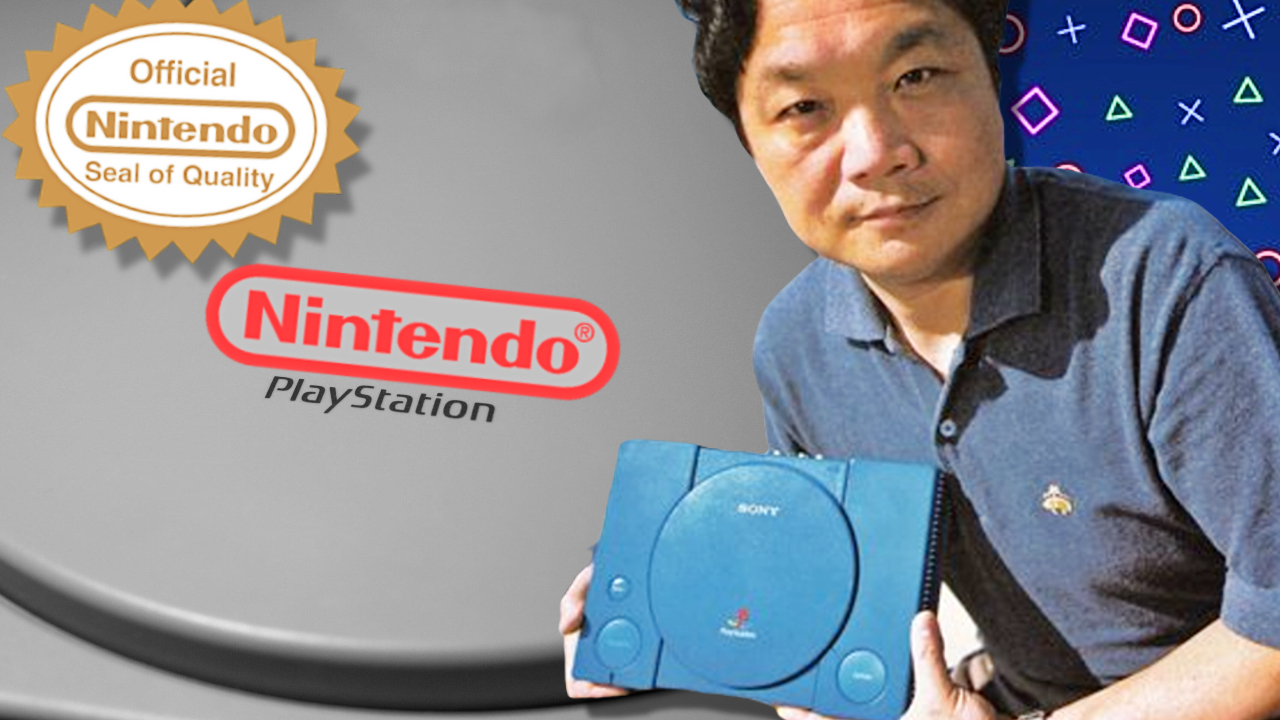
How Nintendo Betrayed Sony and Created the PlayStation
Today, when we talk about video games, everyone almost exclusively thinks about Nintendo, PlayStation, and Xbox as being the big three console manufacturers. If you’re a PC gamer, then you might think of storefronts like Steam and Epic Games. But it wasn’t always this way. Video games first started to gain popularity at home in the 1970s thanks to the Atari 2600, which transported games like Pong and Pacman from the arcade cabinet to your TV screen. And in a similar way, it wasn’t until the 1990s when Sony’s PlayStation brought us proper 3D graphics and cinematic for the time quality, laying the foundations for the games industry as we know it today. The concept of the PlayStation, however, didn’t just come out of thin air. The idea for the PlayStation actually came about because of Nintendo, who inadvertently turned Sony from a company who made TVs and sound systems into their main competitor in a move that they are still reeling from today. This is the story of how Nintendo betrayed Sony and created the PlayStation.
The Nintendo Betrayal – How Nintendo Created PlayStation
Our tale begins in 1988, when new tech coming out of Japan was booming and the money was flowing. Nintendo had already taken the home console market by storm in 1985 when they created the NES, and they were hard at work on developing its successor – the SNES. Sony was riding high from their Walkman sales and was innovating in audio visual equipment, but they weren’t content to rest on their laurels. A man going by the name of Ken Kutaragi, now dubbed the ‘father of playstation‘, was head of Sony’s hardware division at the time. His daughter had become obsessed with Nintendo’s NES (or Famicom as it was known in Japan), and this is what got thoughts swirling in his head. Could Sony do something in video games? If they could, he would be the well-placed man in the Japanese salaryman hierarchy to do it.
It didn’t start out, however, with Sony aiming to completely dominate the market. In fact, Kutaragi approached Nintendo and started a symbiotic working relationship by convincing them to use Sony’s SPC-700 audio chip in their upcoming SNES. Kutaragi admired Nintendo for innovating in the home console arena and believed home consoles were the future of entertainment at home. It all seemed to be going great, until corporate Japan struck. The course of video games could have looked very different today, because in June of 1989, Kutaragi was almost fired by Sony. He had been working with Nintendo in an unofficial capacity and hadn’t alerted Sony to his relationship with Nintendo. Luckily, Sony’s president at the time saw the potential in the new audio chip he’d developed for the SNES and decided to mentor Kuturagi. The father of PlayStation had escaped demise by the skin of his teeth.
Nintendo’s success with the NES had led them to experiment with creating accessories for the console. One of these was called the Famicom Disk System, which was a giant box that sat under the Famicom and used Nintendo’s proprietary floppy disks called Disk Cards. These Disk Cards allowed Nintendo to enhance its existing games and also create titles like The Legend of Zelda, which otherwise would’ve been impossible without the Famicom Disk System. So, what does this have to do with Sony? Well, it was Nintendos first foray into new storage mediums with the Famicom Disk System that would set them on a road they would never be able to recover from; a road that would lead to the creation of the Sony PlayStation.
Due to the success of games like Zelda and Metroid on the Disk System, Nintendo saw the potential in exploring new storage mediums. That’s why when developing the SNES in the late 80s and early 90s, they were exploring what they could bring to their latest and greatest console. This happened to overlap with their new working relationship with Kuturagi and Sony, and it wasn’t long before the two companies were in talks. Impressed with Kuturagi’s new audio chip, Nintendo contracted Sony to use their expertise in the audio world and create a CD-ROM add-on for the SNES. This would tentatively be called the “SNES-CD” or “Play Station”, note the gap between “play” and “station”, because this will become importantly later.
Sony was giving full effort to these new developments, and they even planned to develop their own home entertainment system that could play CDs and SNES cartridge games once their work on the SNES was over. This would all be created with proprietary Sony CD-ROM technology they called Super Discs. And it was this Super Disc format that would be used in the SNES add-on. Due to the contract the two companies had signed, Sony would retain the international rights to every single Super Disc game created, no matter what system it appeared on. Team blue was also pushing the licencing of this technology in music and film, seeking to obtain a dominant market share in what they – correctly – saw as the future of storage media. However, this was all getting too close to home for Nintendo, who recognized that Sony ambitions were on a collision course with their own.

Things came to a head at the 1991 CES show, when the Nintendo SNES Play Station add-on was scheduled to be revealed. Nintendo President Hiroshi Yamauchi was getting cold feet and rethinking the deal he had struck with Sony 3 years prior. He recognized that the original contract would give Sony the rights to every single game that Nintendo developed for the SNES CD-ROM, which, in turn, would give Sony de facto control over a significant amount of the games they were going to produce. While Sony wasn’t really a player in the video game market at the time, Yamauchi knew that Sony possessed a large research and development team that were just chomping at the bit to get their hands on Nintendo’s IPs and put their own spin on them. So, without telling Sony, Yamauchi cancelled the existing plans for the joint CD-Rom attachment. Yamauchi then sent executives to the Dutch company Phillips, a direct competitor of Sony’s, to strike a deal that would allow them to create a CD-ROM add on for the SNES, but also keep their rights to all games. This system would later come to be known as the Super NES CD-ROM, but it would never actually officially hit the market.
In the ultimate snub – one that would cost them dearly for decades to come – Sony’s Ken Kuturagi and its head of PR Noboyuki Idei would only learn of Nintendo’s decision to take their business elsewhere just two days before CES was set to begin. Understandably upset, Kuturagi tried to contact everyone involved to find out what was going on, but he was ghosted. Despite this, Sony went ahead with their plans, and on the first day of CES announced their partnership with Nintendo and the SNES. At 9am the very next day, Nintendo took to the CES stage and announced that it was now allied with Philips and would abandon their work with Sony. In his 2015 work “the playstation book”, Damien McFerran calls this one of the most infamous double crosses in video game industry history, and he’s right. Nintendo’s actions left Sony publicly humiliated. The company had expected this to be its big video game breakthrough, but instead, they were made fools of while Yamauchi sat back in glee. But, as it turns out, this was a huge mistake on Nintendo’s part, because Sony wasn’t going to lie down without a fight.
Nintendo’s move was a major snub in Japanese business culture, which had an unwritten rule that Japanese companies wouldn’t turn on each other in favour of foreign ones. Filled with rage at the betrayal, Kururagi and Sony’s CEO decided that they would just go ahead and develop their own console anyway. Sony of America tried to convince the Japanese executives to partner with Sega instead, saying that Sony knew nothing about video game hardware or software, but Kuturagi and his team wouldn’t listen – they were hell bent on going their own way. They were convinced Sony’s forward-thinking approach would offset their inexperience, and they were fed up with partners letting them down. Sony was going to create not just a rival to Nintendo’s SNES, it was going to dominate the market and make Nintendo regret having crossed them.
Internal opposition to Sony’s involvement in video games, however, was rife. Kuturagi remained adamant that the company shouldn’t stop pursuing video games because it was a rapidly growing industry in the early 1990s, but the old guard at Sony, who were risk averse, tried to put blockers in Kuturagi’s way. Despite this, he pushed on. In the summer of 1992, Norio Ohga, Sony CEO and Kutagi’s mentor, chaired a meeting with the company’s top leadership to decide on the future of a possible Sony video games division. It was at this meeting that Ken Kutaragi revealed a secret project that he’d been working on. It was a a proprietary CD-ROM-based system that could play games with immersive 3D graphics. It was far more advanced than the recently released SNES console. Ohga was enthusiastic and supported Kutaragi’s project as he had done the throughout, but the other members of the meeting who were older were still opposed to the idea. They saw Nintendo as a toy company and considered video games part of that category; they wanted to focus on their audio-visual roots that had a more sophisticated and adult market, or so they thought. The irony is that it would be Sony who would be responsible for adding a more mature veneer to video games when the PlayStation eventually released, but more on that when we get there.
The Sony PlayStation was officially announced in October 1993, but internal conversation were still unsure of whether the console’s games should be 2D or 3D. 2D had been tried and tested for many years, but 3D was too new to tell if it would be just a fad or not. Luckily, Sega’s Virtua Fighter came out in Japanese arcades and was instantly a smash hit. It was like a sign from the heavens for Kuturagi and his team; they settled on creating 3D games for the PlayStation and never looked back.

Development of the Sony PlayStation
Unlike their two major competitors in the video game industry at the time, nintendo and sega, Sony had absolutely no experience developing first-party video games. This meant that they would have to rely upon third-party developers to create games for the PlayStation. In a strange twist of fate, it seems that Sony wasn’t the first company that Nintendo had snubbed, and the new kid on the block quickly found support from the likes of Namco and Konami who were also fed up with Nintendo. Kuturagi new that securing third party support would make or break the launch of his new console, so before the end of 1993 he had already secured ridge racer, mortal kombat 3, and tekken for the console.
Since Sony was already building on work that had already been done, the PlayStation’s development moved quickly. The company partnered with lots of different Western studios, like Peter Molyneux’s Bullfrog, who would eventually bring games like Populous and Theme Park to the PlayStation. Games like this were thought to only be possible on a PC at the time, but because of the PlayStation’s sophisticated 3D engine, they were showing up on consoles for the first time. Western developers who got their hands on PlayStation development kits pre-release also praised Sony for letting them used PC-based systems for developing games, and that their disc reading system allowed for a more efficient workflow.
The technical specs for the PlayStation were finalised in 1993, while the hardware would be finished the next year. Sony weren’t waiting around, either, and in December 1994, the PlayStation launched in Japan. At this point, I think it’s useful to step back and appreciate the rapid changes Sony implemented here. Just two years earlier, Sony’s biggest ambition had been to develop a cd-rom add-on for Nintendo, but after Nintendo’s betrayal, team blue had managed to develop a full console. Having no experience in the games industry, they secured a significant amount of third-party support, and also managed to please developers and publishers with forward-thinking hardware and support. All of this took place because Nintendo, in all of their arrogance, decided to cast Sony aside like a cheap coat from TEMU.
So, with all of that said, just how successful was the PlayStation at launch? And how did Sony go from unknown quantity to arguably the best-known name in gaming?
How PlayStation’s became a household name
The PlayStation first launched in Japan in December 1994, and this came just one week after the Sega Saturn. The Saturn hit store shelves at $399, while the PlayStation undercut it with a $299 price tag. If you truly want to understand how Sony dominated this era with their first console, we need to look at the state of the landscape. The Sega Saturn was more expensive and destined to flop for a multitude of reasons (one of them being the PlayStation itself), and Nintendo’s first 3D console – the N64 – wouldn’t launch until 2 years later. Not only was there simply no competition to the PlayStation, the console was futuristic and shocked gamers with its movie-like 3D images. Yes, it’s hard to really appreciate that now in a world of 4K HDR, but in 1994, the PlayStation was cutting edge tech for cheap. Sony knew what they were doing.

Needless to say, the PlayStation’s initial success in Japan was stunning. Long queues formed outside electronics shops across the country, and Sony’s CEO Norio Ohga knew he’d made the right choice by backing Kuturagi when his friends and relatives started begging for the console. The PlayStation sold 100,000 units on the first day and two million units within six months of launch, an absolutely incredible amount for a company with no history in video games and selling only in a single country.
In summer of 1995, Sony brought their popular console to E3 in Los Angeles. The audience reaction was wildly popular and garnered a lot of applause from the crowd. How important this event is in gaming history cannot be understated, with some saying that it changed gaming forever. On September 9, 1995, the playstation went on sale in the US and within two days outsold the Sega Saturn’s entire previous 5 months. Sony’s dominance can be seen in two similar games from the time that were duking it out; one being the PlayStation’s Ridge Racer game and the other Sega’s Daytona USA. Critics considered Ridge Racer a superior game, and on top of that, the PlayStation had a whopping 17 games available at launch, compared to the Saturn’s 6. A couple of weeks later, the PlayStation released in Europe and once again walked all over Sega’s Saturn sales.
The PlayStation would go on to sell over 102 million units in its lifetime, making it the 6th best-selling console of all time. To put that into perspective, the SNES sold 49 million, the NES sold 61 million, and the N64 sold only 32 million. The PlayStation even outsold the notorious Wii console, and in fact, the only Nintendo console that would outsell it is the Nintendo Switch. To put this in perspective, we’re talking about a console from a company who had never made anything to do with video games in their entire history, and who suddenly appeared on the scene and broke all kinds of records.
This success, of course, set Sony on the path to even more greatness. Because Kuturagi had been so adamant on the project and it had paid off more than their wildest dreams, Sony invested heavily in the next generation. The PlayStation 2, as we all know, would then go on to be the best-selling console of all time, still yet to be beaten. And this is how Sony’s PlayStation brand came to be one of the major three players in video games today. It started with a business contract that was broken, with Nintendo laughing Sony out of the room with petty malice. And in one of the greatest comeback stories ever told, the PlayStation was a revenge project headed up by Ken Kuturagi and Norio Ohga.
But not only did the PlayStation create a name for itself and financial success for Sony, the console also changed the gaming landscape and how the hobby is perceived. It was the first console to add dual thumbsticks to a controller with the release of the dualshock. It was also the first console that wasn’t seen as simply a toy. With games like Metal Gear Solid, Silent Hill, and Resident Evil, the PlayStation showed the world that gaming was actually for adults, that gaming could be a place for art and not just mindless entertainment to stop your ADHD kid bouncing off the walls (am I speaking from experience? Maybe). Regardless, the PlayStation brand was here to stay. Cementing its place in the industry over 30 years ago, Sony’s PlayStation has actually become one of the main focuses of their business, which is a far cry from the days when Kuturagi was trying to convince the old guard to let him make a games console.
Video games might look very different today had Nintendo allowed Sony to make the CD-ROM add-on for the SNES, or if they simply hadn’t signed a contract in the first place. There might be no Sony PlayStation whatsoever, and who knows what kind of butterfly effect ripples that would have sent through the video game industry – would we even have a Microsoft Xbox if Sony hadn’t proved that games weren’t just toys for kids?
Read about the game that will destroy your soul.


