
Has Gaming Peaked Now?
Gaming has peaked – at least that’s the conclusion I’ve come to after looking back at what video games used to be and what they’ve become. Every time a new console came out, there would be a massive jump in power. Every time a new game franchise came out, it wowed us with creativity. Every time new tech dropped , whether that be in TVs, controllers, or hardware, we would scramble to have the latest and greatest. But now everyone is making handhelds, companies, studios and publishers are always firing their teams, and we seem to be going backwards in regards to what games are popular. Graphics are no longer king, and indie games are growing ever more popular. So what happened? And where are video games going from here? Join me as we explore why gaming has peaked.
Since the early days of video games, companies have pushed for bigger and better. From gobbling up dots as Pac-Man to shooting down alien craft in Space Invaders, game developers pushed the bounds of what video games were capable of being. The innovations came thick and fast in the early days, and in a space of 15 years we moved from controlling a couple of pixels on the Atari 2600 to playing as Sonic on the Sega Genesis and then Solid Snake on the PlayStation 1. To put that in perspective, 15 years ago, we were still playing the Xbox 360 and PlayStation 3. So, while at one point it only took 15 years to move from the most basic game possible to full 3d graphics, in the recent past that innovation has slowed down and we simply haven’t seen a big jump in graphics from the 360-era to now. From this, we can see the building blocks of part of the reason that gaming has peaked. For some reason, once full 3D graphics were achieved, there was less and less that companies seemed to be able to strive for. Apart from VR, of course, but more on that later.
But even though massive graphical leaps started to slow down, the PS2 showed the world that video games were more than just graphics by becoming the best-selling console of all time to date. Yes, the graphics were better than the PS1 it replaced, but it also promised a slew of great games, like Silent Hill 2, Metal Gear Solid 2, Timesplitters, Ratchet and Clank, and tons more. The original Xbox also joined the scene, pioneering the PC in a box strategy that Microsoft has since followed, bringing the company’s success with desktop computers into the gaming realm. It had a built-in hard drive and was a chonky powerhouse.
As we move into the Xbox 360 and PS3 era, we start to see more modern hardware transformations, like the inclusion of a Blu Ray drive on Sony’s console. The graphical power of these consoles also saw a nice leap, but the main selling point touted by gaming companies was that we were moving into the era of high definition. Everyone started yeeting their big CRT TVs into the trash, replacing them with thin and sleek flat screens that were capable of doing 720p resolution. So, then, a large part of the seventh generation was bringing gaming into modernity by changing the peripherals we used to consume our games through. This is particularly evident in the Nintendo Wii, whose main gimmick was the Wiimote and motion controls (something that has stuck in the form of gyro controls today but boy did those grandmas love bowling).

While gaming was starting to peak the mountain, it hadn’t quite reached the summit yet. 2013 saw the release of the PS4 and Xbox One consoles, and with them the move to true 1080p hd graphics. We also got great new games like God of War, Uncharted 4, Bloodborne, and a boatload of others. Half way through the generation, we got the PS4 Pro and Xbox One X, which truly moved video games into the hot new thing coming down the pipe: 4K resolution and HDR. Alongside this, we got the PSVR and wider general releases of the Oculus headsets too. So, while traditional gaming was upping the resolution and graphical fidelity as people bought fancy new 4K TVs, virtual reality was treading new ground with how we actually play games. No longer would we need a controller to control our in-game heroes on a TV screen; we were not in the game itself, and it was set to be the way video games we would play all our games. VR was the future, except it wasn’t. A lack of mainstream support has meant that VR has gone largely underutilised by developers for a number of reasons. The physical space needed in your house to throw yourself around in VR is quite significant, and nobody tells you just how exhausting it is playing games in VR after a full day of work or school. And even if you do manage to motivate yourself to put the headset on, a good chunk of people still deal with motion sickness.
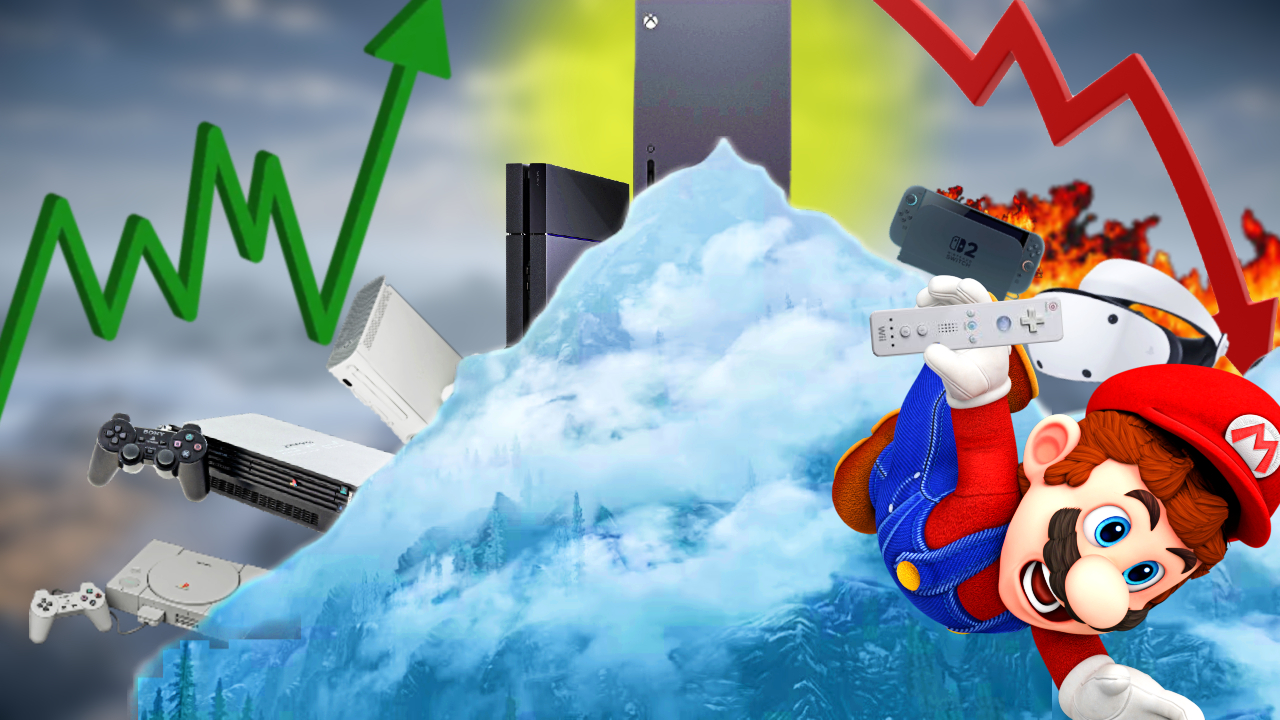
So, that brings us to the current 9th gaming generation of the PS5 and Xbox Series X, which is where I think we not only reach the video game summit but start to lose our footing and slip and slide down the other side. See, the problem is that, 5 years into this console generation, we’ve stagnated. The PS5 and Series X both promised 4K resolutions at 60 FPS, but that’s something that we already had with the PS4 Pro and Xbox One X. Sony’s PS5 Pro does add additional horsepower to the mix, but really the upgrade differences are almost negligible, and in some cases they’re worse. (see my video on the PS5 Pro for more on how in some cases the console is a downgrade and not an upgrade). Just take God of War vs its ps5 sequel ragnarok for example, where the graphical differences are imperceptible to the naked eye at a normal viewing distance. And we only have to look at Sony’s psvr2 to see that even if you’re a giant video game publisher, that doesn’t guarantee that people will adopt your fancy new technology. Frankly, psvr2 hasn’t really even moved the needle forward for most gamers – it’s just an expensive gimmick that hardly gets games. And before you get mad, I own a psvr2, so this is spoken from my own experience.
We’ve spent an awful lot of time talking about hardware upgrades and how it all fits into gaming’s peak, but there’s a lot to be said for the games themselves and the companies who make them playing a part in the plateau and decline of video games. Where studios used to be free to try out creative ideas for new game franchises, developers are now forced to make games by a corporate committee. You can see this in the stagnation of franchises like Call of Duty, Far Cry, or Assassin’s Creed. Just a few years ago, in the last generation, we started to see these games get monotonous but still have life left in them. Assassin’s Creed had Odyssey, for example, which gave us a compelling world to explore. Call of Duty at least tried different approaches in the form of COD World War 2 and battle royale, but now it’s just Modern Warfare after Modern Warfare.

I mean, just look at Concorde, one of Sony’s most expensive games ever, which shut down just 2 weeks after launch. But what’s most egregious about what happened in Concorde’s case is that the entire studio was laid off like it was somehow their fault that the corporate suits had a terrible idea. This trend is now very common among video game publishers, especially after Microsoft acquired Activision Blizzard. Warner Brothers, for instance, has shut down Monolith, the studio responsible for Shadow of Mordor and F.E.A.R., and who was working on a Wonder Woman game that actually looked pretty good. The upper management at Warner Brothers claim they are refocusing on core franchises, but that’s corporate speak for not taking risks and pumping out the same old schlock.
This is one of the reasons that gamers have been moving more and more towards indie games for their dose of originality, and we’re seeing far more people playing games where you get to create your own experiences in a sandbox. Kingdom Come Deliverance 2, Baldur’s Gate 3, and simulator games like Arma are just some examples of this new way of playing games that’s attracting more and more people, because the traditional AAA industry is just really underwhelming now. There are only a few holdouts left, like Hideo Kojima and Kojima Productions, who focus on creating original and creative experiences, instead of being concerned with the bottom line (although, ironically, the studios who do this end up making far more money.)
What’s also interesting is how we like to play games is changing, and in some cases actually reversing. Remember all of those amazing new consoles that can do 4K, 60 frames per second, and ray tracing that they sold us? Well, it turns out that shinier and more expensive isn’t necessarily better. According to VGChartz, The Nintendo Switch – an 8 year old console – is still outselling the PS5 by around 10 million units per month and double its entire lifetime number at 150 million. The popularity of other handhelds like the Steam Deck also confirm that cutting edge graphics aren’t what’s important to gamers anymore now that we’ve reached the graphical plateau. Players are now looking for convenience and cozy factor. Why sit at your PC or on your couch playing Monster Hunter Wilds when you can snuggle up in bed? Heck, I even played Disco Elysium on the Nintendo Switch because of that very fact, and traditionally, I’m someone who looked forward to getting that extra few frames or resolution out of my games.
There have always been ups and downs across the history of video games; ebbs and flows where the industry has crashed and bounced back. But there has always been something on the horizon to get us giddy with excitement or pulling out our wallets. The current state of affairs, however, seem to show that video games have peaked. We’ve summited the graphical mountain, and resolution is now diminishing returns. We’ve summited the VR mountain and found that actually we don’t want to dance around our rooms all of the time. Reached the peak of creativity, and I don’t think even large publishers themselves know what to do about that. In all forms, then, gaming has peaked, and the slide down is looking awfully steep.


