
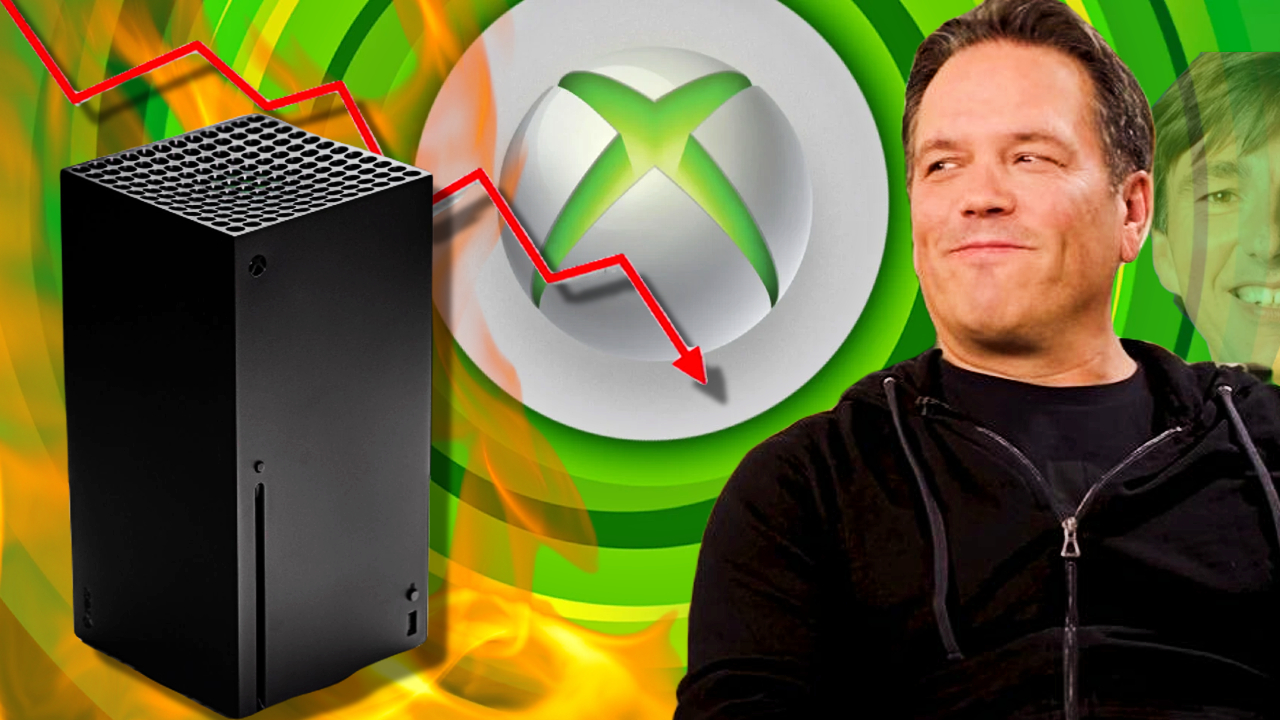
How Phil Spencer Let Us Down and Ruined Xbox
The Xbox executive team, headed up by Phil Spencer, has been on gamer’s naughty list lately, with Xbox making a series of unpopular moves that have left us scratching our heads and wondering: weren’t they supposed to be the good guys? Wasn’t Phil Spencer supposed to be the guy next door who borrows your copy of Die Hard Trilogy on the PS1 and promises he won’t scratch it but then when you barge into his bedroom 2 months later to reclaim it, it’s unreadable? Maybe that’s just me. Anyway, were going to explore how Phil Spencer’s reign at Xbox has been underwhelming and hasn’t delivered on the promises they’ve made to US – the game players, the gamers, the button mashers, the rizzmasters, the randanglers, the hermits, the sun-hating vampires.
To really get into why Phil Spencer has steered the company in a bad direction and gotten us into the mess we’re in today, we first need to rewind to his predecessor to see how those events shaped Spencer’s takeover and also explain why his moves are such a slap in the face today.
Don Mattrick was an executive at Electronic Arts until 2007, when he was asked to takeover the gaming side of Microsoft. He quickly became instrumental in shaping the Xbox 360’s future by developing the Kinect, which he unveiled at E3 in 2009 alongside Steven Spielberg for a huge PR stunt. In 2010, he was promoted to oversee other areas of Microsoft, and things remained largely quiet due to the Xbox 360s excellent success against the PS3 at that time. In 2011, Mattrick made it into Fortune magazine as one of the “smartest people in tech”. The article says: “When he first arrived from Electronic Arts to Microsoft in back in 2007, things weren’t well. But Mattrick turned things around with a three-year plan to streamline the business. Mattrick also assembled the team and recruited the talent behind Kinect, the company’s motion-sensor controller for the Xbox 360 that has since become one of the most popular consumer products in recent history.”
But this obsession with the Kinect would be his downfall. Mattrick’s Kinect was a fun novelty peripheral that came out towards the end of the Xbox 360’s life. It was fun and quirky – Microsoft’s own version of the Wiimote that bridged the gap between hardcore gamers and their eccentric grandmas who thought we all still played Pong. But gimmicks like the Kinect are never the mainstay of a gamers toolbox. The Kinect might have been fun, but nobody wants to play every game with a Kinect, just like nobody wants to use the Switch’s motion controls every single time they turn on the console.

Unfortunately for everyone involved, Don Mattrick decided that what gamers wanted, what they REALLY wanted, was a console that HAD to use the Kinect at all times. So, since he was head of Xbox during the development of the Xbox One, he decided that every console should have a Kinect camera bundled in the box, adding another $100 to the price point of the console over its competition, the PlayStation 4, which also had more powerful hardware than the Xbox One. More on this crucial point later.
On May 21st, 2013, Mattrick unveiled the new Xbox One, the successor to the Xbox 360, an all-in-one entertainment system, and it didn’t go down well at all. The Xbox One developed under Mattrick had to always be online and was touted as an all in one entertainment system that could be used as some strange hybrid cable TV box that no one cared about. Mattrick also tried to make you pay a licence to play used games on the Xbox One, something that Sony memed to their advantage.
It was also announced that you also had to have the Kinect hooked up at all times and there were concerns that having a camera pointed at your room while always online and connected to the internet wasn’t a great idea. In a terrible PR move, Mattrick dismissed these criticisms of the Xbox One by saying “We have a product for people who aren’t able to get some form of connectivity; it’s called Xbox 360.” Hmmm, where have I heard that one before?
Despite dropping the need to always be online after such an outrage, Mattrick’s days were numbered. The Xbox One launched later that year to a thud and some tumbleweed, and he was quickly replaced by Phil Spencer a few months later in March 2014.

Whereas Mattrick came onstage dressed in a suit, Spencer took a different approach, making sure to dress in jeans and a T-shirt to show that he was one of us. It’s clear that from the beginning Spencer wanted to distance himself from his precessors poor strategy and marketing. He immediately stopped bundling the Kinect with the Xbox One and began to erase all notion of it and he refocused Xbox’s strategy on the actual games we wanted to play.
But, unfortunately for Spencer, the die had already been cast. The Xbox One’s hardware was set in stone and there was only so much he could do with what he inherited. The Xbox One’s disastrous launch overshadowed what were some amazing first-party launch window games. Ryse Son of Rome, Killer Instinct, Forza Motorsport 5, Zoo Tycoon, Sunset Overdrive, and more all released in the first year of the console’s life. That is far more than the PlayStation 4 had at launch, and had Mattrick not bungled it, the Xbox One likely would have shined bright against Sony’s console.
Phil Spencer made the changes he could with the resources he had at the time. In 2015, he introduced backwards compatibility to the Xbox One, allowing gamers to play their Xbox 360 games on the new console. This is something that Mattrick wasn’t prepared to do, saying in an interview that he didn’t see backward compatibility as a problem. “If you’re backwards compatible, you’re backwards”.
In 2017, Spencer revealed the new Xbox One X, dubbed Project Scropio, which was a more powerful version of the Xbox One aimed at fixing the issues of the Xbox One. Remember when I said earlier that the Xbox One launched overpriced and underpowered compared to the PS4? Spencer knew this and has made it a core tenet of his philosophy to always beat Sony in the power department ever since. Game Pass also launched in 2017, giving gamers excellent value for money by giving us instant access to hundreds of games for a low monthly fee.

It’s in the post-Xbox One X period that Spencer started to really have an impact on Xbox’s future. We start to see people like Larry Hryb take to the official Xbox Podcast to talk to the gamers on a personal level, sarah bond started being open and transparent about xbox services and features like game pass and backwards compatibility, and the whole time spencer made sure that the focus was on the games and that the communication was clear.
By the time the Xbox Series X rolled around in 2020, Phil Spencer had managed to claw gamers back to Xbox with his pro-gamer stance. Game Pass was great value, accessibility on Xbox was at an all time high, and the top-level execs had managed to cultivate an image of being the gamers next door. This is in stark contrast to Sony, who remains very business-like to this day.
But now Spencer had a console that he was in charge of from beginning to end, with no outside influence from the likes of Mattrick, so how did it all go so wrong? How did we get into the position we’re in today with mass lay offs and a bleak future for team green?
The answer lies in the actions of Xbox’s executives and their strategy. See, while their rhetoric has remained the same for the past 4 years of this console generation – make great games and the gamers will follow – Spencer and his team have failed to actually deliver on their promise. Despite sucking up major studios like Bethesda, Activision Blizzard, Rare, and many more, we haven’t actually seen much come from these acquisitions.

Fantasy adventure Avowed has been teased for years, but we haven’t actually seen any real gameplay for the game, and Obsidian and Xbox have only offered tentative release dates. A Perfect Dark reboot has been in development for years, yet no one has even had a whiff of what’s going on. And despite acquiring Bethesda, perhaps Xbox’s best weapon, their middle-of-the-road attitude to letting all gamers play equally has meant that they didn’t lock down games like Starfield as an exclusive. Instead, they chose to let those games release on PlayStation and other platforms too.
Speaking of Starfield, the games that were toted as being must-haves for the Xbox have largely been flops and failures. Take Redfall for example, a cool multiplayer vampire-slaying game made by Arkane? It can’t possibly go wrong, right? But it did. It went horribly wrong. Fittingly, Redfall was more lifeless than a vampire’s victim.
Xbox has an Xbox problem right now. Phil Spencer has spent the last decade making Xbox all about the games and focusing on making great games that are accessible to all, but in doing so, he’s taking a more PC-like approach. This means we’re now seeing more and more Xbox first-party titles make their way to the likes of the PlayStation 5 and Nintendo Switch, as we’ve seen with Sea of Thieves. Does this make sense for an altruistic, good guy approach? Sure. Does it make sense for Xbox fans? Certainly not.
The questions is that if Xbox under Spencer has become all about the games, then don’t we want to play those games on the Xbox ecosystem? This is where we run into issue number two – Game Pass. Since launching in 2017, Game Pass has moved to PC as well. You would think that makes sense seeing as most PCs run in Microsoft Windows, and it does. But what worries me is where else Xbox wants to take the service in the future.
Xbox has been pushing cloud integration and remote play, and many Xbox fans have speculated that the future of Xbox lies in Game Pass and not unique Xbox hardware with unique Xbox exclusive games. This is backed up by the likes of GameSpot reporting that Xbox CFO Tim Stuart stated that they have changed strategy with Xbox and now want Game Pass on PlayStation, Switch, and every screen possible.

So it’s easy to see that Xbox plans to move towards a streaming-only service in the future, even if that’s 5 years or 10 years in the future. No longer will you have to be a proud owner of an Xbox console – you can play Xbox Studios-made games anywhere. But what if you shut down all of the studios who make your games? Because that’s what Xbox has just done.
In an email to Xbox Studios employees, Matt Booty said that the company would be focusing on high-impact games and that they were shutting down a number of Xbox Game Studios Arkane Austin, Tango Gameworks, and Alpha Dog Games, and that Roadhouse Games would be folded into ZeniMax Online Studios. This is nothing other than utter madness.
Tango Gameworks released Hi-Fi rush to excellent reviews in a pivot from their previous series The Evil Within. Even Xbox’s Aaron Greenberg took to X to say that it was a breakout hit. Needless to say, it makes no sense to fire all of the great talent at these studios, especially after they create blockbuster hits for you. Bloomberg’s Jason Shrier has reported that there are still more studios on chopping block, with more cuts imminent. And now, there are even rumours floating around that there might be a price increase for Game Pass.
Players are so angry about all of this that there has been a huge outcry from fans, with one person even nuking Phil Spencer’s Fallout 76 base. And fans are right to be angry because this flip flopping is exactly what Spencer was supposed to have remedied a decade ago. He promised us it was all about the games and that gamers would come first, but at the same time, he’s shuttering the studios who make the games.
For all of former PlayStation CEO Jim Ryan’s faults, he understood that when it came to the PS5, Sony needed to give us great games that you can only play on their console. It gave us a reason to invest in the console and subsequently it pushes the industry forward as more people adopt new technology. They backed this up by remaking fan favourite demon’s souls as a must-have and PS5s flew off the shelves so fast they had trouble stocking them for years.
How Phil Spencer Ruined Xbox and Let Us All Down
This is all to say that Phil Spencer and Xbox have let us, the Xbox fans, down. We gave Xbox faith after the Xbox One fiasco and they promised to give us great games and to rectify that bad will that Mattrick had put out. And they did that up until the Xbox Series X. But since the latest console’s release in 2020, it’s been nothing but a rocky road.
Halo Infinite was delayed and didn’t arrive at launch, and when it did come out, most people quickly put it down. There have been some good games sprinkled around, like Forza Horizon 5, but the reason to a actually own an Xbox in this generation simply hasn’t been there. The Series X is a great console, but the UI is a small step from the 10 year old Xbox One dashboard. You can play every Xbox Series X game on other platforms and consoles. And the first-party games are, frankly, not as excited or up to the quality that you find on the PlayStation 5.
With their comments lately, it seems like Xbox has given up the quote unquote console war. While I don’t believe in taking sides and own all of the platforms, I’m still unsure what it means to be an Xbox gamer. When I turn on my PlayStation 5 and play Horizon Forbidden West, it makes sense. I’m spending time with the only console that can play that game, and it’s exciting.
If Spencer is moving Xbox into a console-less future where they plan to just sell you Game Pass that can be used anywhere, then there won’t be a sense of community anymore. And Xbox’s community started way back in 2001 with the original console. So while it might be nice for everyone to play Xbox games on whatever console they have, it’s a slap in the face to fans that have supported the company for the best two and a half decades.
Read Is Strange Double Exposure a true Life Is Strange successor here.


