
The Last True Handheld – the Legacy of the Nintendo 3DS
The other day, I started to wonder what ever happened to my Nintendo 3DS. So I started doing what any sane person does, and that’s turn the house upside down and dig around in the attic until I found it and started puzzling with Professor Layton again. In the subsequent weeks after finding my 3DS (XL I might add), I found myself simply closing the clamshell and sticking it in my pocket when I went places. I never do that with my Switch, which lives almost exclusively in its dock. It became clear to me that something was amiss – why was I taking a handheld that came out in 2013 with me everywhere when I have a Nintendo Switch and Steam Deck that are loaded with all the latest games?
One day, as I was tickling the screen with the stylus and pondering why Layton hangs out with a child, I glanced over at my docked Switch, and that’s when it hit me: we really need to dive deeper into the topic. We need to find out what makes the Nintendo 3DS the last true handheld gaming device that we’ll see in our lifetime.
We’re going to explore the history of the Nintendo 3DS and how the console came to be the phenomenal success that it was. We’ll also be examining its quirky hardware, wide range of amazing games, how it developed a unique community around it, and why the Nintendo 3DS still beats newer portable consoles to this day. This is the sad legacy of the Nintendo 3DS.
History
It all begins in November 2004, when the Nintendo DS hit store shelves and took the gaming world by storm. The DS was the first handheld console in Nintendo’s arsenal that wasn’t a GameBoy, and it was the successor to 2001’s Game Boy Advance. The Nintendo DS came with a stylus, two screens, and had a clamshell design. It flew off store shelves and the Japanese giant knew they had made the right decision in trying something new and innovative, doing away with the small and square Game Boy design. The Nintendo DS would go on to have a long life and lay the groundwork for the 3DS, with games like Ace Attorney and Professor Layton outlining Nintendo’s new handheld philosophy of dual screen stylus wiggling.
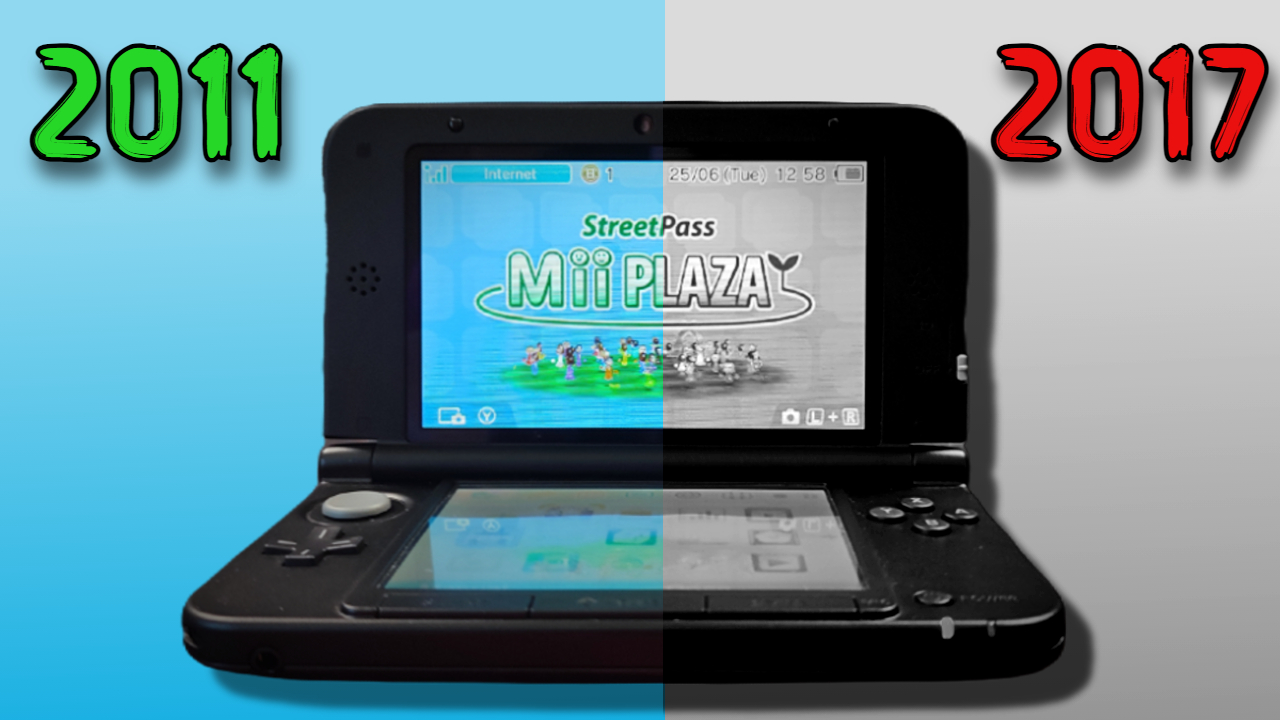
7 years later, in March of 2011, Nintendo released the Nintendo 3DS, the successor to the popular Nintendo DS. Because of the DSes break out success, they would take the if it’s not broken don’t fix it approach and iterate on the Nintendo DS rather than creating a wildly new concept. The most notable change the 3DS made is by sporting a larger screen in widescreen aspect ratio. The DS screens had been 4:3, which makes sense because when it came out, we were all still watching gigantic CRT televisions.
The new main screen on the 3DS was also 3D, which was a technology that was all the rage at the time. Sony’s PS3 could be played in 3D with special glasses and theatres were showing movies in 3D, so Nintendo jumped on the bandwagon by basing their whole console around the concept. Luckily, as we’ll discover later, they built in one crucial feature that saved the 3DS when the 3D fad quickly went away.
Other new features for the handheld were a built in gyroscope, motion sensor, GPS, augmented reality via the 3DS improved and more numerous cameras, and an actual analog stick (well, nub thing). The 3DS was also much more powerful than the Nintendo DS, which was something that the community really wanted after spending 7 years with its predecessor.
Right away, the Nintendo 3ds began gaining a reputation for being the go-to place to play amazing handheld games. The list of top-tier games available on the system is endless, and we’ll explore them later in the video. The Nintendo 3DS would go on to sell almost 76 million units in its entire lifetime. And while Sony’s PS Vita launched in the same year and looked set to provide stiff competition for Nintendo, a series of misfires resulted in the PS Vita only selling a measly 10-15 million units. So, for the purposes of this video and for those wondering why were not considering the PS Vita the last true handheld – that’s because Sony killed it.
Despite having smash hit after smash hit and selling almost as well as the hit Nintendo DS, the 3DS would effectively become irrelevant in March 2017, when the Nintendo Switch released to cover up the Wii U fiasco. That means that the 3DS’s reign lasted barely 6 years, and marks 2017 as the last time we had a true gaming handheld with full support from its creator.
But hold up, I hear you say, what about the Switch, Steam Deck, and numerous other portable gaming consoles that have come and gone since? To answer that, we next need to look delve a little deeper into the 3DSes hardware, games, and community to find out what sets it apart from the competition.

Hardware
Let’s begin by talking about the 3DSes main theme – the actual 3D nature of the console. It is in the name, after all. Earlier we learned that Nintendo followed the contemporary trend for technology at the time, which was to jam 3D capabilities in everything and make you wear funny looking glasses in your own home. It was a a fad that quickly died out when everyone realised it wasn’t actually that good, so what happened to the 3DS? The short answer is – nothing, thanks to one ingenious move by Nintendo. When the Japanese company first developed the console, they decided to put a slider on the side of the 3DS that controlled the strength of the 3D effect that players saw when using the handheld. This extended to even allowing you to completely remove the 3D effect by turning the slider all the way down, effectively making it a superpowered DS. This was the way a significant percentage of players – myself included – used the 3DS due to the annoying way that you had to hold the 3DS in just the right position to get a good experience.
The Nintendo 3DS’s clamshell design was just generally accepted by players during the console’s lifetime, but looking back now, it was a move of sheer genius. We were already used to this design because of the DS and flipphone era, all of which had screens with a clamshell design that closed in on itself to protect the screen. But today, in an era of tablet-like portable gaming devices, the clamshell design has been lost and no one uses it anymore. However, the clamshell design was one critical area of hardware that – though we didn’t know it at the time – was instrumental in prompting us into taking the 3DS everywhere we went. Let me explain.
Part of the Nintendo 3DS’s charm is that you can throw it into your pocket as you’re heading out the door and you don’t have to worry. You know the screen will be protected without any additional screen protectors and the worst those keys in your pocket are going to do is scratch some of the paint on the outer casing of your console. I don’t know about you, but with each of the four Nintendo Switches I’ve bought – don’t ask, Nintendo get me with their special editions every time – I’ve immediately purchased a screen protector and case for it. Despite just being able to fit in a large pocket without a case, at no point have I ever thought “hey, let me just grab my switch and throw into my pocket and take it with me.” And that’s for two reasons. One because of the sheer size and weight of the thing. The Switch Lite is better in this regard, of course, but it’s still no 3DS. The second reason is that it’s just far more prone to damage, even with a screen protector. Aside from the screen, the thumbsticks also catch on your pockets, and the long and thin profile of the Switch means it wobbles precariously when you walk around. Compare that to the 3DS’s shorter and fatter nature, which sinks to the bottom of your pocket nicely. In the end, I think this rules out modern consoles like the Switch and Steam Deck as “handheld” consoles that are in the same league as the 3DS. They are certainly portable, but if you have to worry about cases, screen protectors, and whether they even fit in your pocket (looking at you Steam Deck), then it’s clear that the 3DS is in another league when it comes to being actually handheld. More modern portables are larger because they are vastly more powerful than the 3DS, but does that mean the actual games are better? Let’s look at the 3DS’s library to find out.

Games
So now we’ve discussed the physical consoles themselves and how the 3DS’s design is a lost art that propelled itself into people’s pockets all over the globe, we’re going to find out just why more graphical power doesn’t equal better games. The Nintendo 3DS has one of the best library of games in the history of gaming.
Games that came out in the six years between launch and the Nintendo Switch include heavy hitters like Ocarina of Time 3D, A Link Between Worlds, Majora’s Mask 3D, Bravely Default, Pokemon Sun and Moon and X and Y, Monster Hunter 4 and Generations, Super Mario 3D Land, New Super Mario Bros. 2, two kirby games, two professor layton games, two Ace Attorney games, Mario Kart 7, Animal Crossing New Leaf, Resident Evil: Revelations, Luigi’s Mansion: Dark Moon, and many more that would make this list way too long.
You might see a pattern in that all of these games are top tier and reviewed extremely well in the gaming media. But you might also have realised that these are game series that have lived on with new entries on the Nintendo Switch. However, this doesn’t mean that just because they look better on the switch that the experience is actually better. Let’s take Animal Crossing for example. Animal Crossing games play roughly the same across the whole series, the idea being you start a new life somewhere and get indebted to a capitalist racoon who owns a monopoly on your new life. Each day plays out in real time and it’s meant to be played in short sprints while you’re on the go. New Horizons on Switch certainly looks better than New Leaf on the 3DS, but the way you end up actually playing the game is different even if the concept is the same. For example, since the 3DS is so easy to take with you, you end up actually playing the game how it was meant to be played, quickly watering your crops on your lunch break and so on. Since the Switch is more difficult to carry around, it ends up feeling like more of an ordeal.
The games across the 3DS and more powerful, modern portables is also different. For example, the ace attorney and professor leyton games would never have been developed for the Switch. Despite the stylus being older technology, it’s still far more precise than a fat old finger, which means that you can pinpoint areas for investigation as phoenix wright or solve those pesky puzzles as leyton and company. Those are just two examples, but the point is that while the Switch can play all the latest modern games that are on PC, PS5, and Xbox Series X, that doesn’t mean those games are better. And in fact, trying to have the most power so that they can play the latest games, modern portables have become even more generic in their character. The 3DS had game exclusives that were unique to the way you played the 3DS, and the console ended up popularizing games like Monster Hunter despite them being on other platforms. 3DS games gathered players that would huddle together in public places to share Pokemon and race in Mario Kart, and that’s something that you simply don’t see as much anymore. This leads us to another reason the 3DS was the last true handheld – the community.

Community
When it comes to the Nintendo 3DS, you can’t help but notice that the community for the game was and still is huge. A large part of this was StreetPass and collecting other players’ Miis. Since the 3DS was a product of the Wii era, it utilized stylishcustom avatars that each player created as part of their Nintendo profiles, which Nintendo dubbed Miis. StreetPass was an application that came pre-loaded on every 3DS and allowed users to collect other 3DS owners’ Miis when they came in physical proximity to each other. This worked by simply closing your 3DS so that it was in rest mode and walking near another 3DS player who had done the same thing. When the 3DSes are close enough, they work some woo-woo magic and communicate with each other, trade Miis, and then the other person’s Mii appears in the MiiPlaza app on your 3DS. By going to MiiPlaza, you can see all of the Miis you’ve ever collected and by proxy all of the people you’ve encountered over the years. It was and still is common for those still rocking a 3DS to still take their console with them to places like Japan, where the userbase for the handheld is still large. In fact, Nintendo Life even made a video about this, where they used Street Pass every day for a year. In it’s heyday, however, StreetPass was hugely popular. Gaming events and gatherings were full of people using their 3DS to scoop up Miis and friends for Miiverse.
Miiverse was Nintendo’s de-facto social network, which ran from 2012 to 2017, when the Switch was released. Similar to Street Pass, Miiverse allowed you to share handwritten messages, drawings, and screenshots with your friends on the service. This worked in a very similar way to how Splatoon’s plaza posts, where users can draw their own (often hilarious) doodles. Despite living for only 5 years, Miiverse was adopted by Nintendo fans to almost the same extent as Street Pass.
Needless to say, these two features helped the Nintendo 3DS gain a huge community following that had a distinct personality. And this is where we start to really start to encounter the sad legacy of the 3DS. See, when Miiverse was discontinued in 2017, Nintendo didn’t replace it with anything. The Switch has a generic friends list that lets you see what your friends are playing and all of the features found on other consoles, but you can no longer post and draw like you could on Miiverse. Combined with the more generic hardware we discussed earlier, the lack of distinct social features has also significantly contributed to the erosion of the Nintendo community since the 3DS was pushed aside for the Switch. The 3DS’s community is remembered fondly by those looking through their nostalgia glasses for good reason. It was an era of unprecedented community that is almost inrivalled elsewhere in the gaming world.

Why the 3DS is the last true handheld
You have probably started to see why the 3DS might be considered the last true handheld, but there’s a big sony shaped specter looming on the horizon, and that’s the PS Vita. TECHNICALLY, the PS Vita wasn’t discontinued until 2019 according to PlayStation, but those are extremely rare outlier cases that came out of Japanese manufacturers. The second and final PS Vita model to hit the West was sold between 2013 and 2014, but most people will tell you the PS Vita was long dead by that time. Sony notoriously stopped supporting their handheld early. We’ll save diving any deeper for a future video dedicated to the console, but it should be clear that the 3DS lived on far longer than Sony’s offering.
We touched on this earlier, but we also have to remove the Switch, Steam Deck, and other similar portables from the handheld equation. These devices are not true handhelds in the same sense as the 3DS. If you have to bring a whole buttload of accessories and worry about your console getting messed up, then you don’t fall into the handheld category. A similar sentiment can be shared when it comes to the library of games seen across all of these devices. Switch and Steam Deck have great games, but because you can now play most games on many different platforms, developers have lost the art of making a proper handheld game, where thought is given to the smaller screen and setting in which you would be playing.
The sad legacy of the 3DS
And this, ultimately, brings us to the sad legacy of the Nintendo 3DS and the erosion of the handheld community. When the Nintendo Switch launched in 2017, it was clear Nintendo wanted to merge their home console and handheld console communities into one entity. The Switch could be played according to your preference – at home on a big TV or on the go – and it was easier for Nintendo and developers to simply focus on creating one game that would satisfy both audiences. But in doing this, Nintendo stripped the identity from the handheld community. It didn’t continue any of the fun features that promoted Nintendo fandom like StreetPass and Miiverse. Games were no longer developed with their handheld nature in mind, they were simply normal games on a smaller screen, which led to issues like tiny, unreadable text. And despite being able to be taken places, Nintendo didn’t consider the idea that no longer was handheld gaming able to be a lifestyle with the Switch; the 3DS was always in gamers’ pockets ready to go, but the same can’t be said of its successor.
While the Switch is a great console, the merging of communities in March 2017 killed the handheld community for good. Every portable console after the Nintendo 3DS has essentially been a beefed up iPad, and don’t get me wrong, they’re good at what they do. But everyone who owned a Nintendo 3DS can’t help but look back fondly at the days when handheld gaming was a lifestyle with a giant community. The trend across the gaming world is now for games to be available on more and more systems; to becoming platform agnostic and bring gamers together in a generic mix. This is great for accessibility, but it’s clear we’ll never see an era like the Nintendo 3DS again, and that’s the real tragedy here. The sad legacy of the Nintendo 3DS is to be forever locked in a handheld gaming era we’ll never return to.
Find out how Insomniac’s best game flopped here.


