
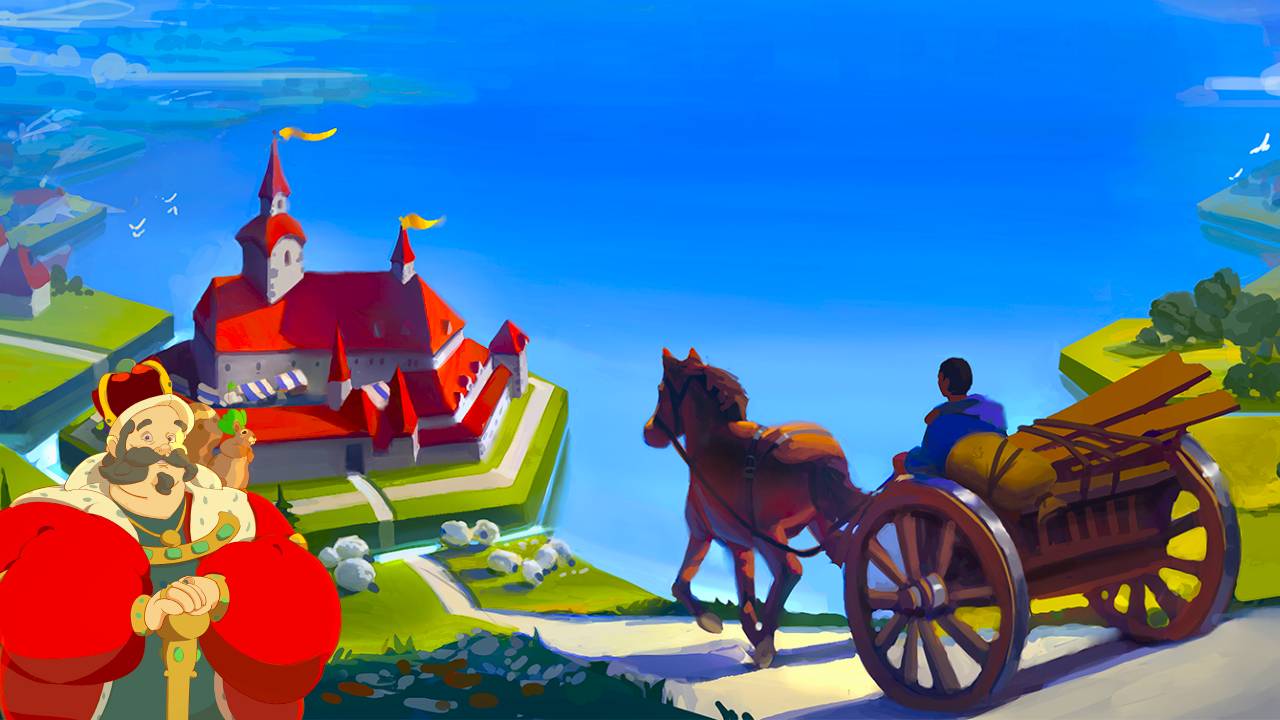
Let Them Trade Review – The Wolf of Diphtheria Street
Let Them Trade isn’t so much a city building game as it is a trading game. It’s in the name, I know, but from the outside, you’d be forgiven for thinking it looks a lot like a hex-based strategy game like Civilization. However, Let Them Trade is firmly in the economic, money-making camp. That might sound boring, but because of its relaxed vibe, it’s quickly become a game that I can’t put down. Honestly, I wasn’t expecting to have so much fun with it. That doesn’t mean that there aren’t any downsides, because like the S&P 500, it has both peaks and troughs. So, grab a snack and beverage of your choice, and settle in for our full Let Them Trade review.

Let’s state the obvious: Yes, Let Them Trade looks like Civilization (or insert other hex-based strategy game here), but once you get stuck into the game, you start to realise that it really does carve out its own niche. For instance, simply pan the camera around and you’ll realize that you’re playing a real board game similar to Catan, on a real table, in a real room, with a real cat. So, the meta mind games begin before you even touch get your filthy hands on those controls.
Now, I’m going to try to explain how Let Them Trade works, but let’s just say that you will need at least a passing knowledge or interest in the basics of supply and demand. You shouldn’t be put off by that fact, as despite Let Them Trade’s name, it does lean in a more casual direction than a lot of other spreadsheet simulators masquerading as strategy games.
The basics are that you start the game with a castle keep, like any good medieval lord does (did I mention it has a medieval setting? Well, it does). Then, you build town centers and peasant houses to populate your new settlement. Then, based on where you founded your new town, you can create wood cutters and potato farms. There’s an upgrade tree that then allows you to unlock and build more types of buildings so that you can then mine stone, fish, and more. So far, so Civ right?

Well, this is where things start to get a bit different. You need to connect these towns together and to your castle by creating a road so that they can trade. At a basic level, you can create whatever types of industry wherever you want, but this is where the supply and demand starts to come into play. For example, if one town is near lots of trees, then it’s best to dedicate that town to logging. Another town that’s near, say, fertile fields would be a good place to build several potato farms. The reason that you want to create hubs of industry, rather than diversifying each town so that it creates a little bit of everything, is to create trade.
If a town creates lots of one product, it has a surplus and then trades it with the other. The potato farming town, for instance, will be lacking in wood because it doesn’t have any way to fell trees, and vice versa. This forces each town to import from the other, driving prices up. “But why would you do that!” I hear you scream, and that’s a great question. As king of this kingdom (or queen, if you’re fabulous), you’re entitled to taxes. And taxes are paid every time one settlement purchases items from the other. That’s right, we’re creating a burdensome economy for the little guy in his hovel while we sit back in our ivory tower and reap the benefits because we can. Who said this game was unrealistic?
That sounds basic, but the waters quickly become muddy when you increase the number of towns you found, decide what industries they will specialise in, then connect them via road and bridge. Each town needs to be managed by you, and that includes making sure there are enough peasants, upgrading buildings and towns for faster and more efficient trade, and researching upgrades for the future. If you don’t dive into the settlement screens to see who is producing what and how much, then you could very quickly find yourself in a downward spiral of bankruptcy.
This is further complicated by the various technology trees, which have the equivalent of Civ or Age of Empires’ “eras.” Peasants might be the only people required to cut down trees, but when you start researching more advanced tech like bakeries or coal mines, then you need workers. These do the same job as peasants in essence, but the connotation is that they are more skilled and therefore you need them specifically to work in the more complex buildings. This goes higher and higher until you reach aristocracy, but without going through the tech tree exhaustively, I think you get the idea.

As the game goes on, it gets more and more complex, and more advanced manufactured products are needed to keep buildings running or research further upgrades. That means it’s up to you to finely balance how many peasant houses versus worker houses you need, and what tiles can be demolished to make way for fancy new tech. The fact that towns have only a limited number of hex slots at each upgrade level only exacerbates these problems. You can also send scouts out to fight bad guys, which throw a big ol’ wrench in the works.
Let Them Trade has a full tutorial, a campaign that walks you through ever more complex objectives, and a sandbox mode. These are all fully fleshed out, but the campaign does feel like more of an advanced tutorial. Sandbox mode is where you’ll really get to sink your teeth into creating a trading kingdom that rivals the Silk Road, with no objectives to hold you back from total domination.
While there aren’t many, the negatives of Let Them Trade will affect your overall enjoyment of the game. Even though I went through the tutorial and campaign, it took a long while for me to truly get to grips with the game’s complex systems. While the interfaces are easy to navigate, it’s tough to understand where or why you’re lacking in resource production unless you go down and click on specific buildings and towns. It’s this kind of niggly annoyance that is spread throughout. You won’t really have an overview of each town’s population until you select it and hover over specific little icons, and the same goes for resources. It doesn’t help that Let Them Trade is also intent on having each town keep a separate log for these things either, and there’s no real way of quickly getting an overview of your whole kingdom (or at least I didn’t find one, which kind of speaks for itself). This will ease a little as you learn the game’s quirks, but it can be frustrating for several hours when you’re just starting to understand how the complex trading system works.
Once you have gotten to grips with the game’s systems, you’ll find that there isn’t that much to do aside from progress through the ages. Whereas a game of civilization usually ends with Gandhi firing nukes all over the place, Let Them Trade simply doesn’t have that kind of jeopardy. It’s a game for those who really do enjoy trading, statistics, and efficiency – a more casual version of something like Crusader Kings, Stellaris, or Factorio.
Regardless, I very much enjoyed playing Let Them Trade, and I found myself playing more and more, getting addicted to watching the little carts haul resources and trading goods to and fro. Let Them Trade markets itself as a casual game, and it is considering the genre it is in, but it isn’t casual in the sense that you would let your grandma try this. Please don’t let your grandma try this.
Let Them Trade Video Review
Let Them Trade: Let Them Trade is an engaging game that provides a unique take on the strategy-esque genre. Rather than fighting, its focus is on trading between medieval settlements, and it somehow makes that something fun. It does, however, falter by not clearly explaining some of its more complex systems very well, and the game’s UI could provide more clarity at a macro level so that you don’t have to try to track down your peasants individually to see what they’re up to. Regardless, Let Them Trade is a charming, calm, and casual (for its genre) trading game that will hook you in and make you wonder why on earth 15% extra logging output gets you excited. – Jesse Gregoire


